Integrating artificial intelligence in global environmental education: insights from COP28 and prospects at WEEC12

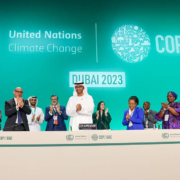
The recent COP28 held in Dubai has raised concerns within the environmental education community due to the absence of the term “education” in the discussions and strategies outlined. It is crucial that the concept of education be meaningfully integrated into global climate strategies, and the opportunity to do so presents itself tangibly at the 12th World Congress on Environmental Education (WEEC12) to be held in Abu Dhabi.

In particular, special attention is sought for the use of Artificial Intelligence (AI) in the field of environmental education. The transformative potential of this technology in enhancing the effectiveness of global climate education is clearly evident. Events related to COP28 have preluded this discourse, highlighting the fundamental and innovative role of AI in making sustainability approaches accessible and engaging.

The debates arising from events connected to COP28 clearly demonstrate that AI can play a crucial role in making environmental knowledge more widespread and engaging. Collaboration between environmental education experts and technology developers can contribute to the development of innovative educational tools and resources that fully leverage the potential of AI.

WEEC12 represents a unique opportunity to place the central role of environmental education on the agenda, with a specific emphasis on the integration of Artificial Intelligence. Addressing this issue proactively and collaboratively could shape a more sustainable future, where environmental knowledge becomes a driving force in the global fight against climate change.

Join our network and become part of the conversation on COP28! Send your contributions to secretariat@weecnetwork.org and help shape the environmental dialogue.

COP28 reminds us all of the urgency to attend WEEC12 in Abu Dhabi!

by Dr. Costis Toregas, The George Washington University
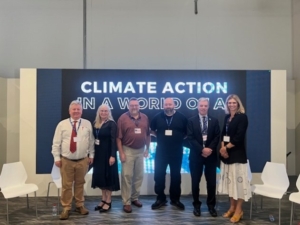
Left – right: Gerry Cunningham (EAGLES 2030) , Pat Cummens (Esri), Sean Breyer (Esri), Lee Mallon (Humanity), Erwin Rose (US State Dept), Valerie Hawley (Sorbonne Univ.)

The text that emerged from the lengthy discussions during COP28 just concluded in Dubai was hotly debated, and engaged the participants in difficult discussions of what language to include and which to exclude… and for some in the Environmental Education (EE) community, it rang a warning bell!  A quick key word search revealed that the word “Education” did not appear even once!  Of course no one will argue that education should be part of any global solution to climate change and the challenges of sustainability.  However, the modalities and strategies that will bring education as a supporting platform to the vital COP28 action verbs of Finance, Capacity Building and Technology Transfer must be rapidly deployed, discussed and agreed upon by relevant stakeholders.

And what a better place to do so than at WEEC12 in Abu Dhabi on January 29 through February 2, 2024!

To align the education agenda to the Technology Transfer actions, we can focus on the use of Artificial Intelligence (AI) in Environmental Education (EE), catalysing climate action  and contributing to environmental education.  In recent years the role of artificial intelligence (AI) has gained significant attention across the environmental and academic community.  The world is facing the triple planetary crisis – climate change, biodiversity loss and pollution – and technology and innovation has a key role to play in addressing these challenges.  There is an urgent need for innovative solutions to educate and engage the public in sustainable practices. This pathway will be amply demonstrated at WEEC12, with three sessions dedicated to the role of AI in enhancing the effectiveness of environmental education irrespective of geographic location, language barriers or technical infrastructural constraints.

To foreshadow these panels and underline the importance of EE, there were events at COP28 that addressed AI’s role in promoting new ways and tools for educators.

“AI is emerging as a powerful tool for how we learn about and interact with the environment, particularly through repackaging information and enhancing personalized learning experiences” said AI expert Lee Mallon, CTO of Humanity, Abu Dhabi at a COP28 side event on AI (see photo).  “Artificial Intelligence possesses the remarkable capability to transform extensive, 100-page reports on positive climate action into finely detailed narratives. This approach ensures that every individual across the globe can grasp the necessary steps for climate action. It tailors the information to align with the media channels that resonate most effectively with each person, enhancing their understanding and engagement in impactful environmental action”.

Other participants in the side event included US representative Erwin Rose who laid out a clear path for AI’s introduction as a powerful tool to support sustainability through the Climate Technology Centre and Network, eSRI representatives detailing location-based AI advances and EAGLES2030 chair Gerry Cunningham who offered practical strategies for implementation through collaboration.

Job opportunity at UQAM: professor position in environmental education with a focus on youth, environment, and education

The Université du Québec à Montréal (UQAM) is pleased to announce the opening of a Professor position at the Department of didactics, specializing in environmental education, with a particular emphasis on “Youth, environment, education.” This opportunity aligns with the university’s commitment to renew its faculty and promote high-quality development across all areas of activity.

The selected individual is expected to commence duties on June 1, 2024, subject to budgetary approvals. This position offers a range of responsibilities, spanning from teaching to research development and mentoring students at the graduate level.

Key responsibilities:

  1. Teaching and course development: The selected candidate will be responsible for teaching and developing courses at the undergraduate and graduate levels in Environmental Education, particularly in teacher training and educational interventions for young people.
  2. Research in environmental education: Contribute to the development of research and the mobilization of knowledge in the field of Environmental Education, with a focus on “Youth, Environment, Education.”
  3. Supervision and direction of research: Provide guidance and supervision for theses, dissertations, and other research projects at the graduate level.
  4. Contribution to the research center: Actively participate in the activities of the Research Center in Environmental Education and Training (Centr’ERE).
  5. Academic engagement: Participate in departmental, faculty, inter-faculty, and inter-institutional academic activities.
  6. Interinstitutional cooperation: Contribute to the development of interinstitutional cooperation activities and collaborations with a variety of sectors.

Requirements:

  • Doctorate or doctoral studies in progress in the field of Environmental Education or another relevant field.
  • Expertise in teaching and research in Environmental Education.
  • Demonstrated ability to work collaboratively and manage team projects.
  • Skills in developing and fostering collaborations and partnerships.
  • Good knowledge of the local, regional, and international context in Environmental Education.
  • Proficiency in the French language, both oral and written.

Assets:

  • Knowledge and experience in the educational sector.
  • Proficiency in English and Spanish.

Priority will be given to Canadian citizens, Canadians, and permanent residents in accordance with Canadian immigration requirements.

Interested individuals are invited to submit a complete electronic dossier before January 15, 2024, at 5:00 PM. The dossier should include a signed cover letter, a detailed and signed curriculum vitae in French, excerpts from three relevant recent publications or achievements, teaching evaluation reports if available, written confirmation of the initial thesis submission (if applicable), and three letters of recommendation sent directly by the authors. An electronic version of the completed doctoral thesis or the accepted version of the thesis project should also be included.

UQAM encourages diversity and subscribes to an employment equality program, actively encouraging women, Inuit, Métis, First Nations members, visible minorities, ethnic minorities, and persons with disabilities to apply.

For more information on the application process and position details, please refer to the UQAM website at the following link: apply for this position

Illuminating the green future: distinguished speakers at the 12th WEEC in Abu Dhabi

With the twelfth World Environmental Education Congress (WEEC) set to take place in Abu Dhabi from January 29 to February 2, the world will have the opportunity to listen and learn from a cadre of visionary experts and leaders in the environmental field. The Congress, which is already open for registrations, will serve as a catalyst for ideas and discussions aimed at shaping a greener and more sustainable future in the realm of education.

Spotlight on international visionaries

The speaker lineup comprises internationally renowned figures, experts, and industry thought leaders, all united by a common passion for environmental education and sustainable development.

H.E. Shaikha Al Dhaheri – Secretary-General, Environment Agency – Abu Dhabi

Dr. Shaikha Salem Al Dhaheri, Secretary-General of the Environment Agency – Abu Dhabi, will be among the distinguished speakers. With a Ph.D. in Wildlife Conservation and Protection from the University of Aberdeen in the United Kingdom, she is the first Emirati woman to achieve this accolade. Her leadership is crucial for safeguarding natural resources and promoting sustainable development in the emirate.

H.E. Razan Khalifa Al Mubarak – President, IUCN

Her Excellency Razan Khalifa Al Mubarak, President of the International Union for Conservation of Nature (IUCN), brings over twenty years of commitment to a sustainable future in the United Arab Emirates. Her election as the president of IUCN in September 2021 makes her the second woman to lead the organization in its 75-year history and its first president from West Asia.

Akpezi Ogbuigwe – Chairperson, Earth Charter International Council, and Regional Advisor for Africa, UNU/RCE’s

Dr. Akpezi Ogbuigwe, a respected practitioner in environmental law and education for global futures, will be present as the Chairperson of the Earth Charter International Council. Her diverse experience includes roles at the United Nations Environment Programme (UNEP) and as Adviser for the African Region at UNU-RCE’s.

Carlos Alvarez Pereira – Vice President, The Club of Rome, Spain

Carlos Alvarez Pereira, Vice President of The Club of Rome, will contribute his over 30 years of experience in research, innovation, entrepreneurship, and business management. His keen interest in complexity thinking and transdisciplinarity is vital for exploring the cultural transformation required for equitable human well-being within a healthy biosphere.

David Orr – Professor of Environmental Studies and Politics and Senior Adviser to the President of Oberlin College

Prof. David W. Orr, a Paul Sears Distinguished Professor of Environmental Studies and Politics and senior adviser to the president of Oberlin College, will bring his wisdom as a founding editor of the journal Solutions and as the executive director of the Oberlin Project, a collaborative effort for the resilience, prosperity, and sustainability of Oberlin.

Elizabeth Wathuti – Kenyan Environmentalist and Young Climate Leader, Kenya, and Founder of the Green Generation Initiative (GGI)

Elizabeth Wathuti, a dedicated environmentalist and dynamic young climate leader from Kenya, will be a strong voice for environmental preservation. As the Founder of the Green Generation Initiative, she played a crucial role in supporting the largest delegation of African youth at COP27 in Egypt.

Jeffrey Sachs – President of the UN Sustainable Development Solutions Network and Director of the Center for Sustainable Development, Columbia University

Prof. Jeffrey D. Sachs, University Professor and Director of the Center for Sustainable Development at Columbia University, will bring his extensive academic and advisory experience to promote sustainable development goals.

Judy Braus – Executive Director, North American Association for Environmental Education (NAAEE)

Judy Braus, with her wealth of experience in environmental education, assumes the role of Executive Director of the North American Association for Environmental Education. Her focus on diversity and inclusion is crucial for creating healthier and more sustainable communities through education.

Ricky Kej – Internationally Renowned Music Composer, Environmentalist and Professor

Three Times Grammy Award Winner, Awarded as the United Nations “Global Humanitarian Artist,” UNESCO MGIEP Ambassador, UNCCD “Land Ambassador,” UNICEF ‘Celebrity Supporter.’

Three-times Grammy Award-winning Indian music composer and environmentalist Ricky Kej will bring his passion through music. In addition to his musical achievements, Kej serves as a UNHCR “Goodwill Ambassador,” UNCCD Land Ambassador, and UNESCO – MGIEP “Global Ambassador for Kindness.”

Building a green future through environmental education

With such a prestigious lineup of speakers, the twelfth WEEC Congress promises to be a unique opportunity to inspire, enlighten, and trigger crucial discussions to shape a greener and more sustainable future in the field of education. Participation is open to all who share the mission of building a better world for everyone, based on a deep understanding of the environment and environmental education. Do not miss the opportunity to be part of this extraordinary experience.

For more information and registration details, visit WEEC 12 website

Speaking 4 the Planet 2024: youth voices resonate for wildlife conservation in Vietnam

In a bid to spotlight grassroots initiatives addressing environmental challenges, Speaking 4 the Planet (S4P) 2024 is poised to unfold on January 21 and 22 at Vietnam’s Cat Tien National Park. While the event caters to students from Đồng Nai, Bình Phước, and Lâm Đồng provinces, its impact reverberates globally, highlighting the urgency of wildlife conservation. The theme, “Speaking for those unable to Speak,” guides participants as they delve into sub-topics like illegal wildlife trade and the symbiotic relationship between a green lifestyle and biodiversity.

Expressive narratives across categories
S4P’s four categories—Speech, Writing, Art, and Drama—serve as platforms for nuanced explorations of the chosen sub-topics. From persuasive speeches to catchy slogans and visually engaging artworks, each entry artfully intertwines the selected sub-topic with the broader theme. Drama, a dynamic category, unveils short performances shedding light on the intricacies of environmental challenges.

Recognition for creative advocacy
Judged by a discerning panel, entries are evaluated on creativity, relevance, and thematic alignment. The S4P competition, rooted in the belief that art and science complement each other in sustainability advocacy, offers prizes recognizing exceptional contributions. The winning team, crowned for their artistic and persuasive prowess, will receive 15,000,000 VND, with additional accolades for the second and third place. Individual achievements across categories will be celebrated with 1,500,000 VND each.

S4P: a blend of art, science, and global conversations
Beyond a conventional competition, Speaking 4 the Planet embodies an artistic journey into sustainability education. The fusion of science and the arts at S4P envisions science as the provider of essential data and the arts as transformative vehicles for societal change. As the 2024 competition unfolds, the Cat Tien National Park becomes a canvas for Vietnamese youth to articulate their perspectives on the planet’s health and their future. Speaking 4 the Planet 2024 transcends regional boundaries, fostering global conversations on the vital intersection of human actions, biodiversity, and environmental preservation.

The journal “education relative à l’environnement” celebrates 25 years at UQAM

The education relative à l’environnement journal marks a quarter-century of dedication to research and practices in the field of environmental education. Founded in 1998 at the university of Quebec in Montreal (UQAM), it remains the only scholarly journal in the french language dedicated to this field of study.

To commemorate this significant milestone, a special event is scheduled for Tuesday, December 12, from 3:00 pm to 5:00 pm at the Woodwork Room of UQAM (J-2805). The celebration will kick off with a special presentation titled “The twenty-five years of the environmental education journal: a research heritage,” presented by Lucie Sauvé and Étienne van Steenberghe, prominent figures in the publication.

Following the presentation, a roundtable discussion on “The future of research journals: current challenges and issues at the heart of the francophonie” will take place. Participants in this discussion include madame Louise Poissant (scientific director, fonds de recherche du Québec – society and culture), Madame Sophie Montreuil (director of Acfas), mr. Vincent Larivière (university of Montreal), and mr. Yves Gingras (university of Quebec in Montreal). madame Louise Vandelac (Institute of environmental science, UQAM) will moderate the exchanges.

After the guest presentations, the audience is invited to engage in an interactive discussion about the current challenges facing francophone scholarly journals. Among the contributors to this discussion is madame Katel Colin, director of Programs and partnerships at the fonds de recherche du Québec.

The celebration will conclude with a friendly gathering over a drink, providing an ideal opportunity to network and celebrate this outstanding achievement together.

Organizers encourage potential attendees to confirm their presence by sending an email to revue.ere@uqam.ca. For any logistical questions, feel free to contact them.

Don’t miss this significant event that highlights the rich heritage of the “education relative à l’environnement” journal and explores the future outlook of research journals in the francophone world.