Towards a Planetary Alliance: A Symphony of Hope How could an educational surrealist methodology bring about such a transformation?

Jacques de Gerlache & Patrick Corsi


Abstract In order to address the challenges of the Anthropocene relating to the fractured relationship between humans and nature, and in line with the objectives of No Limits to Hope, we propose innovative educational practices that can be adopted as policies. These practices aim to empower educators and practitioners to drive systemic change, incorporating existing knowledge, including traditional and indigenous wisdom. This paper particularly proposes establishing a transdisciplinary reconnection of knowledge systems. This vision requires the integration of all planetary components — ecological, spiritual, cultural, social, economic, and political — while respecting socio-cultural diversity and epistemological pluralism. This approach transcends traditional disciplinary boundaries, creating a holistic transformation of minds, mentalities, science, and worldviews. At the heart of this methodology lies René Magritte’s surrealist technique, which shows how art and science can come together to break free from fixed ways of thinking. Magritte’s paintings and their accompanying titles establish a dynamic relationship between reality and imagination, revealing the invisible through the visible and prompting shifts in consciousness. His work exemplifies the interplay of concepts and knowledge that is necessary for paradigmatic shifts. This transformative agency aims to overcome economic drifts, democratic fatigue, and divisive pseudo-truths through education and collective solidarity. The Alliance aspires to create a global agora, fostering shared experiences and mutual trust in order to realize a multicultural, symbiotic planetary destiny. The ultimate goal is a harmonized planetary community that functions like an Olympic convention, where cultures share experiences rather than compete, creating a planetary symphony based on mutual trust, solidarity, and benevolent compassion, and escaping the contemporary threats of nihilism and pseudo-truths.

Keywords: Transdisciplinarity – Planetary Governance – Reconnection – Magrittean – C-K theory.

1. A Planetary Vision Within the Human Dimension

1.1 A planetary alliance for rights and duties
“Reconnect” is the theme of the next World Environmental Education Congress (WEEC) in 2026. The Congress aims to contribute to the in-depth reorganization of knowledge, structures, and laws towards interdisciplinarity and transdisciplinarity. These dimensions are essential to the integration of all the physical, chemical, biological, and sociological components of the planet. Through transdisciplinary education, we can reconnect humanity and nature in a new covenant, reconnecting peoples and cultures. This approach takes full account of socio-cultural diversity, biodiversity, the relationship between humans and nature, and the role of epistemological pluralism. In this context, we could contribute to the adoption of an international Alliance and Convention on Planetary Rights and Duties. Real-time operational controls that ensure compliance with governance rules would establish this reconnection of all components of our planet, including the human dimension, within their specific conditions and ways of life.

1.2 The complexity of planetary life
Planetary life is a complex multiplicity that cannot be separated into its ecological, spiritual, cultural, social, economic, and political dimensions. Many forms of energy — spiritual, cultural, and material — can be mobilized and gathered within multiple groups or associations, from families to local, regional, and national communities. The challenge is to catalyze the emergence of a harmonizing movement in solidarity with an equitable and shared planetary ideal, while respecting the identity and societal autonomy of all biological communities and individuals. In this context, the question for No Limits to Hope is how to reorganize knowledge, structures, and laws toward interdisciplinarity and transdisciplinarity in order to produce a holistic metamorphosis capable of changing minds, mentalities, science, paradigms, and worldviews in each community, affecting all dimensions of planetary life in its complex multiplicity: ecological, spiritual, cultural, social, economic, and political. This recognizes the value of reactivating individual and collective memory, as Theodor Adorno puts it: “The only thing that distinguishes man from the animal is the ability to see the world through the eyes of another human being.” We must face the holistic challenge of catalyzing the emergence of a harmonizing movement in solidarity — a planetary ideal that is equitable and cooperative, and which respects the identity and societal autonomy of all biological communities and their individuals. This requires us to reorganize knowledge, educational practices, structures, and laws.

1.3 Escaping contemporary threats
The weakening of community belonging, a consequence of increased individual freedom, requires the reconstruction of educational pathways that promote harmony. This enables us to escape the barriers of pandemic frustrations generated by primary delusions that make instrumental not only facts but also feelings. Examples of this include Brexit, as expressed by Frans Timmermans in his book Fraternity: Reweaving Our Links. There are threats that attempt to restrict access to courses leading to reasonable outcomes, due to the significant weakening of the sense of belonging to a community — a logical consequence of increased individual freedom. Therefore, it is a matter of education to rebuild this path harmoniously, in order to escape the cancers of hatred and barbarism that some people are trying to impose on us. Steve Jobs captured this intersection beautifully: “I love living at the intersection between arts and sciences. This junction point itself has a magical aura.” We envisage a future of community and planetary diversity, with coherent borders that operate as gateways rather than barriers — like the boundaries between tissues within the same organism. This evolution could be realized by organizing a planetary mobilization resembling an Olympic Convention — a kind of agora where participants share experiences rather than compete. The finals would become a harmonized planetary symphony performed by all communities. This vision is realized through mutual trust and collective solidarity, combining sharing and benevolent compassion with altruism.

1.4 A new form of planetary mobilization
As Frans Timmermans quotes Albert Camus, “The only thing that distinguishes man from the animal is the ability to see the world through the eyes of another human being.” This implies a destiny of community and planetary diversity with coherent borders that are not walls but passages, like those between the tissues of the same organism. This capacity for empathy and perspective-taking is crucial for creating dynamics that facilitate holistic metamorphosis, encompassing intuitive and emotional dimensions, drawing on contributions from both science and the arts. The path to wisdom and universal love is exemplified by Buddha’s teaching: “The teaching is like a raft that is made to cross, not to be clung to.” This evolution could gradually materialize through a planetary mobilization such as an Olympic Convention, where participants share experiences to inspire others rather than compete. The finals would be a harmonized planetary symphony performed by all communities. Education should encourage a destiny based on mutual trust, collective solidarity, sharing, benevolent compassion, and altruism, promoting the realization of a multicultural and symbiotic ideal shared by all humanity. “Let the wise man live in his village like the bee, gathering nectar without damaging the flower in its color or perfume.” For this Convention of Planetary Rights and Duties, the question is how to agree on a new course that escapes storms and passive indifference, particularly in the face of economic drifts and democratic exhaustion. As Régis Debray and Frans Timmermans put it, this route must be adapted to the terrain and obstacles, with foundations, verges, and borders that structure and facilitate mutual exchanges and tolerance, enabling control of excesses. This tolerance is particularly important in the face of the impasses of nihilistic and stereotyped pseudo-truths that claim to be absolute and are progressively imposed by supposed economic, political, cultural, or religious saviors.

2. A Methodological Transformation Through Art

2.1 Introducing the Magrittean approach
A methodological approach to transforming learning and reconnecting humanity with nature could lead to a new alliance for a better future. As Paul Watzlawick said, “It isn’t how things really are that constitutes the problem and should be changed, but the premise of how things should be seen.” Reuniting arts and science requires a transformative agency capable of expressing both. René Magritte (1898–1967) challenges the perceptions of those who observe his work. While contemporary art is often characterized by its ability to abruptly trigger awareness, Magritte engages in a more gradual and unexpected process. His paintings teach key lessons about reconnecting and bringing about holistic change that can transform mindsets, mentalities, science, paradigms, and worldviews. The resonance between the objects in his paintings and their titles reveals how the invisible emerges from the visible, transcending common sense.

2.2 Diving into creative unknowns
In Magritte’s style, the artist of the unconscious reveals the unknown by engaging with the interplay of concepts and knowledge. Moving between reality and imagination, he hybridizes the world, reuniting the mundane with speculative propositions. Rather than using analogies or metaphors, he frames the emergence of a whole as a dynamic unity of painting and title. This overcomes fixed and reductive thinking, offering long-term solutions to alter thought patterns. His work exemplifies a paradigmatic shift, raising awareness of overlooked perspectives on matter, life, and consciousness.

2.3 Calling for a resonant method
Magritte provides a model for transformation. His titles function as undecidable propositions that challenge conventional thinking. Through his method, a poetic dimension emerges — an intuitive dynamic between knowledge, the object, and the image — recalling Saussure’s distinction between signifier and signified. The C–K theory of design models innovation through the interplay of Concept (C) and Knowledge (K) spaces, generating new ideas rooted in established knowledge.

2.4 Exemplifying with C–K theory
C–K structures creative reasoning through four operators: (1) generating root concepts (K→C); (2) expanding concepts (C→C); (3) producing new knowledge (K→K); and (4) reintegrating concepts (C→K). This iterative process builds systemic innovation, such as educational frameworks integrating indigenous knowledge into modern curricula.

2.5 Learning to transcend space and consciousness
For Magritte, both thought and life share thermodynamic processes. His art compels the viewer to “find an elsewhere,” transcending representation to stimulate consciousness. Space becomes a mathematical and conceptual category, transforming how we perceive relationships — a metaphor for the shift needed in education and governance to reconnect the human and planetary dimensions.

3. Conclusion
The key challenge for societies is to implement a metamorphosis of educational policies that empower systemic change. Inspired by Magritte’s topos — the bridge between art and science — this methodology fosters transdisciplinary transformation, reconnecting all planetary components while respecting cultural and epistemological diversity. It paves the way toward a multicultural and symbiotic human destiny built on trust, solidarity, and compassion. By integrating ecological, spiritual, cultural, social, economic, and political energies into a coherent whole, we can achieve civilizational transformation. Education, as the catalyst of this evolution, must cultivate inner values that harmonize knowledge and empathy — enabling humanity to walk a shared path toward wisdom and universal love.
WEEC is partner at the 2025 IUCN World Conservation Congress.

The panel No Limits to Hope: the state of learning (Monday 13th October, 2pm, ADNEC, Abu Dhabi) aims to give voice to various case histories from different parts of the world to strengthen the role of learning as a vehicle for human improvement.

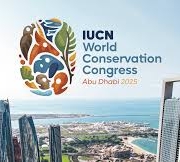
WEEC is proud to announce to be at the 2025 IUCN World Conservation Congress, held in Abu Dhabi, United Arab Emirates, October 9-15, 2025 as official partner of the Nature-based Education Pavilion organized by the IUCN Commission on Education and Communication. The Pavillion hosts thematic days led by experts from formal and non-formal education sectors advancing climate education and biodiversity education around the world.

On October 13, in conjunction with the World Environmental Education Day, WEEC, the Club or Rome, the Fifth Element and the Environment Abu Dhabi Agency present the panel No Limits to Hope (NLTH): the State of Learning.

No Limits to Hope is a significant new initiative led by a flagship programme of the Club of Rome, The Fifth Element, and the WEEC Network (World Environmental Education Congress). This project marks the 45th anniversary of the influential No Limits to Learning report. It aims to unlock the full potential of learning to create positive changes for people and the planet.

The panel held in Abu Dhabi aims to share insights, present cutting-edge research, and engage in dialogue on the current and future landscape of learning worldwide


The speakers

Bianca La Placa, WEEC Network, executive manager
Richard Perry, Adviser Environment Agency Abu Dhabi
Rami Beiram, Associate Provost for Research at the United Arab Emirates University (UAEU),
Toni Chalah  Head of Capability and Competency Development Division Ekthar
Kotoko Yadomaru  President, NatureLit


The World Environmental Education Day was established on October 14th in order to celebrate the first intergovernmental conference on environmental education, organized by UNESCO and UNEP, held in Tbilisi (Georgia) from October 14th to 26th 1977. The coordination of the World EE Day is taken care of by the WEEC Network.


Why Participate?

  • Engage with a global network of educators and practitioners
  • Showcase your research to an international audience
  • Contribute to shaping global learning agendas
  • Explore future collaborations and research opportunities


More info https://iucncongress2025.org/programme/weec-no-limits-hope-and-13weec-2026

Integrating National Education Policy 2020 and Citizen Science: Empowering Young Environmental Stewards for Pro-environmental behavior

Introduction

With a mere 2% of Earth’s total landmass, India has 8% of world’s biodiversity and sensitive ecosystems like Himalayas, Coral reefs, Sundarbans mangroves, Thar Desert, Western Ghats (1). Environment education is a process of creation of environment literacy and development of respect towards nature so that informed and responsible decisions are made (2). The pillars of environmental education are sustainable development, emphasis on real world problem, practical activities, interdisciplinary approach. Practical implication can be created by properly understanding environmental education and its role in shaping attitudes for environmental protection especially by young environmental stewards. ‘Think globally, Act locally’- the slogan related to environmental education has been famous since three decades. With only five years left to completion of target achievement of Sustainable Development Goals, there must be new ways to commensurate actions for solving global problems. It is high times to translate knowledge into practice. Now-a- days students are merely information careers and its high time to turn them into something more so that they act too.

The National Education Policy 2020 is a paradigm shift in Indian education system as it focuses on many aspects that can provide fertile ground for practical approach towards environmental education. It talks about fostering unique capabilities in each student by encouraging logical decision making, creativity, critical thinking, ethics, human and constitutional values like spirit of service, scientific temper, respect for others and empathy. The NEP 2020 focuses on the fact that during these times of Triple Planetary Crisis its very important for children not only to learn but most importantly how to learn. Ancient Indian education system also focused on eternal development and knowledge acquisition not only for school or job but for complete realization and liberation of self (NEP 2020).

Citizen science engages public in scientific research often in collaboration with professional scientists by collecting, analyzing data, reporting finding to contribute to scientific research and policy making (3,4). The student-scientist partnership in a citizen science project is unique as it offers a platform for scientist to work with students, teachers and other community members (5) and students also get real time exposure of the prevailing environmental conditions of their area. In United States there has been a shift in approach to promote interest and understanding of science, there teachers are engaging students in hands-on activities giving them a real-world science away from memorization of facts and rote learning system (6). India could also follow the same model of using citizen science as a tool for real environmental education to youth which also aligns with NEP 20202 principles.

While there are studies on both the concept NEP 2020 and citizen science but there is a significant gap in research that analyze the combined potential to cultivate environmental stewardship in Indian context. So, the authors are interested in knowing how can citizen science be incorporated into the curriculum of Indian schools involving NEP 2020 framework? And what are the key pedagogical benefits to students and overall environmental benefits?

Merging NEP 2020 and citizen science for environmental education

Piaget posits that in traditional method of learning it is not realistic to expect mutual communication between teacher and student. He further argues that what the teacher is saying may not be same as what is heard and perceived by students (6). According to Piaget there are four principles of active learning:

  1. a) Students learn best when they interact with concrete materials and are active.
  2. b) Learning should be individualized and student-centric.
  3. c) There must co-operative work and social interaction in the classroom.
  4. d) Students must construct their knowledge to make it meaningful.

Thus, it can be concluded that learning is constructive knowledge and is effective with concrete materials and hands-on activities.  The above all four principles aligns with tenets of NEP 2020 like- experiential learning; recognizing, identifying and fostering unique capability of each student; ethics; life skills- communication, teamwork, cooperation, and resilience. There is a paradigm educational shift in NEP 2020 in its recommendation such as emphasis on critical thinking development, moving away from rote learning system.

While NEP 2020 has great visions for integrating environmental education but there are some weaknesses causing inconsistent and ineffective implementation in a diverse country like India. Following are some challenges and shortcomings:

  1. Lack of dedicated subject for environmental education- The infusion approach leads to environmental topics being treated as secondary topic in other subjects.
  2. Teacher training- Complex environmental subjects like climate change, pollution, biodiversity loss and sustainable development has been put into lessons. It is difficult for teachers with lack of robust and standardized training to teach students these subjects effectively. This can again lead to rote learning approach where students are only passive information carrier rather than fostering critical thinking and problem-solving attitude development.
  3. Centralized and local issues- The terms like climate change and biodiversity loss are too generic. Environmental issues are highly context specific for example a student residing at desert area of Rajasthan, India must be facing water scarcity and a student living in New Delhi India must be familiar with pollution. A one size fits all curriculum fails to address immediate and local environmental problems that students are familiar with hence making lesson feel irrelevant for them.
  4. Theoretical knowledge over Experiential learning- While NEP 2020 advocates experiential learning through activities, the practical implementation is challenging due to lack of infrastructure, funding, collaborations between scientific community and schools and clear roadmap for fieldwork and community engagement. This often leads to a gap between knowing facts about current environmental issues and feeling empowered to take action.

Citizen Science as a solution for above limitations

Several studies have reported benefits of citizen science in formal and informal educational settings. A study involving Australian undergraduate science students in a citizen science project related to phenology increased their environmental knowledge. The inquiry-based learning increased retention capacity of students by evoking deep thinking in them (7). If a child has to recognize that putting hands in hot water can cause him burn, he needs to try it himself. This can best demonstrate him burn, hotness and what is dangerous. This is called learning from experience. The concept of citizen science gives students and scientists an opportunity to collaborate and learn from experience. The thinking capability is developed when people encounter difficulties in life. This learning by doing is important aspect of Dewey’s educational theory (8). Moreover, students can have real time experience, hands-on learning, knowledge about local environmental condition and issues related with them. For Indian schools involving students in citizen science projects is again a big task. But involvement of multiple stakeholders like school, scientists, policymakers and local government can help in smooth running of any project for multiple benefits to science, society and environment.


References:

1) Thukral, S., Thambi, R., Bhati, R., Gupta, A., & Durve, N. C. (2025). A Review-Biodiversity Conservation Efforts in India and Connection to Climate Change. Ecology, Environment & Conservation (0971765X)31.

2) Vladova, I. (2023). Towards a more sustainable future: The importance of environmental education in developing attitudes towards environmental protection. In SHS web of conferences (Vol. 176, p. 01009). EDP Sciences.

3) https://www.oecd.org/en/blogs/2025/04/what-is-citizen-science-and-why-should-policymakers-care.html

4) https://education.nationalgeographic.org/resource/citizen-science-article/

5) Krasny, M. E., & Bonney, R. (2005). Environmental education through citizen science and participatory action research. Environmental education and advocacy: Changing perspectives of ecology and education, 292-319.

6) Pardjono, P. (2016). Active learning: The Dewey, Piaget, Vygotsky, and constructivist theory perspectives. Jurnal Ilmu Pendidikan Universitas Negeri Malang9(3), 105376.

7) Mitchell, N., Triska, M., Liberatore, A., Ashcroft, L., Weatherill, R., & Longnecker, N. (2017). Benefits and challenges of incorporating citizen science into university education. PLoS One, 12(11), e0186285.

8) Li, Y. (2023). Judging John Dewey’s Views on Education Especially on Hands-on Learning, Student-Centred Learning Approach, and Learning by Doing. Curriculum and Teaching Methodology, 6(22), 58-62.


Pope Francis’ Hope as Praxis of Education: foregrounds hope not as an abstraction, but as an active education practice that decolonizes

I am honored to join the No Limits to Hope Forum and contribute to this urgent global conversation about the future of education. Drawing inspiration from Pope Francis’s vision, I believe that transforming education must begin with a radical commitment to hope—not as naive optimism, but as an active, decolonial force for healing, justice, and ecological stewardship. Educational systems should be rebuilt as communities of care, dialogue, and encounter, where the dignity and voices of historically marginalized peoples are centered and every learner is empowered to be an agent of change. Let us reject models rooted in exclusion, alienation, and “ideological colonization,” and instead cultivate educational environments where cultural diversity, local wisdom, and intergenerational solidarity are valued as essential resources for human and planetary flourishing. Hope, in this context, is not only possible—it is a shared responsibility and the foundation of a new compact for the common good.

  1. Context and Rationale

Today’s world is marked by “epochal change”—environmental collapse, mass displacement, economic injustice, and persistent colonial legacies that drive exclusion and despair. Pope Francis recognizes that education has often played a complicit role in these realities, yet he sees a radical potential for schools, families, communities, and institutions to become sites of integral human development, solidarity, and renewal (Klein, 2023).

The educational “compact” has broken down: responsibility for forming persons has been ceded to market-driven, technocratic models, perpetuating colonial logics and alienation (Klein, 2023). This is apparent in persistent inequality, ecological devastation, and forced migration—failures of both colonial and neo-colonial educational paradigms (Francis, 2018; Pope Francis, 2022).

  1. The Decolonial Character of Francis’s Vision

Francis’s educational proposal is decolonial in both critique and construction. In Pope Francis’s critique of domination, he identifies the root of educational crisis in coloniality and systems that prioritize economic outputs, marginalize indigenous and local knowledges, and disrupt holistic human flourishing (Klein, 2023). Pope Francis argues that integral human development education must nurture the full person—“head, heart, and hands”—not just as workers, but as agents of community and ecological harmony (Pope Francis, 2020; Klein, 2023).

On the pedagogical and epistemological aspect, Pope Francis has called on an Epistemic plurality that prioritizes dialogue as “an intrinsic requirement”—inviting mutual enrichment between cultures, identities, and knowledge systems (Pope Francis, 2018). This pedagogical and epistemological new paradigm should centralize the option for the marginalized: The most fragile and marginalized, especially in postcolonial contexts, must become central actors in shaping education (Klein, 2023).

III. Core Principles and Pedagogical Commitments

  1. Interconnectedness and Care for the Common Home

Education should foster ecological consciousness and a spirituality of global solidarity—healing the rift between humanity and creation, individuals and society (Francis, 2018; Francis, 2015).

  1. Dialogue, Encounter, and Relationality

Francis defines education as an “enterprise that demands cooperation”—a synthesis of reason, empathy, and action—through genuine dialogue, encounter, and inclusion (Pope Francis, 2020; Klein, 2022).

  1. Centering the Human Person in Community

Formative processes must cultivate agency, discernment, and responsibility—especially for the poor, refugees, and historically excluded. This approach overcomes colonial patterns of exclusion and builds up person-in-community (Pope Francis, 2018; Pope Francis, 2020).

  1. Education as an Act of Hope

Francis stresses education as a generator of hope: schools become places where despair and fatalism are broken by acts of solidarity, creativity, and mutual care (Klein, 2022; Pope Francis, 2020). Hope here is not rhetoric, but praxis—fueling cycles of renewal for individuals and their communities.

  1. Implementation: Praxis and Institutional Reform

Pope Francis’s call for a Global Compact is a planetary covenant uniting all partners—schools, families, religious, civic, and governmental bodies—to “mend the fabric of human relationships” and reshape education based on global fraternity (Pope Francis, 2020).

Decolonizing Content, Methods, and Spaces: Curricula must include marginalized histories, indigenous epistemologies, ecological awareness, and dialogue-based pedagogies—eschewing both relativism and neocolonial imposition (Klein, 2022; Pope Francis, 2018).

Schools must be inclusive communities—replacing exclusion and meritocracy with mutual care and civic participation (Pope Francis, 2020).

Teachers, families, and institutions are called to be “artisans of hope”—practicing ethical responsibility and humility before otherness (Klein, 2022).

  1. Contextual Hope: Educational Renewal for Colonized Areas

Francis’s vision resists the determinism of colonial legacy, market logics, and technocratic despair. Instead, it locates hope in: (1)The redemptive capacity of dialogue—where truth and beauty are found in every culture and encounter (Pope Francis, 2018; Klein, 2022). (2) A spirituality of care, healing relationships with self, others, the Earth, and the Divine (Pope Francis, 2020). (3) The creative agency and resilience of learners and communities—able to resist, reimagine, and rebuild systems for justice and authentic human flourishing (Klein, 2022).

Conclusion

This new educational dynamic invites the world—especially those in formerly or currently colonized areas—to leave behind models of fragmentation and domination. It calls for a revolution of hope, rooted in the agency of the marginalized, and realized through acts of care, dialogue, and a passionate commitment to building a truly human, connected, and sustainable common home.

References

Francis, P. (2015). Laudato Si. Paulines.

Francis, P. (2018). Pope Francis’ Apostolic Constitution “Veritatis gaudium” on ecclesiastical Universities and Faculties. https://press.vatican.va/content/salastampa/en/bollettino/pubblico/2018/01/29/180129c.html

Klein, L. F. (2023, March 9). How Pope Francis Sees Education. LA CIVILTÀ CATTOLICA. https://www.laciviltacattolica.com/how-pope-francis-sees-education/

Pope Francis. (2022). Address of His Holiness Pope Francis to Participants at the Seminar “Education: The Global Compact,” organized by the Pontifical Academy of Social Sciences | Uniservitate. https://repository.uniservitate.org/resources-repository/address-of-his-holiness-pope-francis-to-participants-at-the-seminar-education-the-global-compact-organized-by-the-pontifical-academy-of-social-sciences/

Recent Publications on Environmental Regeneration and Global Challenges

Dear Professor,

Based on your efforts and the texts I have read, I thought you would be interested in my latest publications on contemporary issues related to environmental issues and the state of the world.

Please see them below.

With my best wishes for your seminal work.

Kind regards.

André F. Pilon / Assoc. Prof. University of São Paulo International Academy of Sciences, Health and Ecology

Public Profile and Selected Publications:
https://www.unccd.int/science/former-spi-members/andre-francisco-pilon

PILON, A. F. (2025). The Bubbles or the Boiling Water? Ways to regenerate the Earth and Humanity, Katoikos:
https://katoikos.world/analysis/the-bubbles-or-the-boiling-water-ways-to-regenerate-the-earth-and-humanity.html

PILON, A. F. (2024). “The Party of the Dead”: a Tale that Repeats Itself, MPRA Munich Personal RePEc Archive:
https://mpra.ub.uni-muenchen.de/121869/1/MPRA_paper_121869.pdf

PILON, A. F. (2021) Pandora’s Box A Metaphor for today’s World? Researchgate:
https://www.researchgate.net/publication/355684440_Pandora’s_Box_A_Metaphor_for_today’s_World

PILON, A. F. (2024). The Bubbles or the Boiling Water? A Course on Environmental Capacity Building [ppt presentation] Research gate:
https://www.researchgate.net/publication/381996602_The_Bubbles_or_the_Boiling_Water_A_Course_on_Environmental_Capacity_Building

Chanter la Terre, rêver le Monde

« Partout celles et ceux qui s’assemblent pour vivre la Terre et la rêver sont en train d’en réveiller les esprits. »
B. Glowzcewski

Je suis enseignante, retraitée. J’ai travaillé toute ma carrière, en Élémentaire et en Maternelle, avec comme Projet de classe, la Philosophie des 4 éléments de G. Bachelard. J’ai entendu « le cri » de notre Terre, en 1972, à l’âge de 15 ans, en écoutant le rapport du Club de Rome. C’est avec la force de notre expérience professionnelle, enseignés et enseignant, que je reprends le flambeau : « Maintenant nous serons le vivant qui tisse et qui bruisse. »
A. Damasio

  • Quel « Être-au-Monde » pour devenir des « êtres-monde » ?

Et nous nous devons d’espérer sans aucune limite ! Si nous voulons laisser à nos enfants une Terre « Où atterrir ? ». Bien sûr, la tâche est immense. Mais nous savons que notre « À-Venir » commence sur les bancs de l’École. Main dans la main avec les familles.

  • « Vivre la Terre »

Je laisse « une apprentie » dérouler le Fil Rouge de son métier d’élève. Prenons donc le chemin de l’école. Nous voilà dans la cour, mes élèves et moi, au « Premier matin du Monde ». Un cerisier vient de nous offrir son feu d’artifice, bouquets de lumière blanche étincelante.
« À l’ombre des fleurs de cerisier il n’est plus d’étrangers. »
Issa

Écoutons, aussi, la voix de Michel Serres : « La musique n’est pas un art, elle est le moment où toutes les muses vous parlent. » Une enfant de 3 ans n’est pas restée étrangère à la voix des Muses, elle l’a entendue, s’est ouverte à son Souffle, pour en faire jaillir sa propre musique. Magie de l’instant, comme nouveau feu d’artifice, d’une toute jeune « vivante » qui m’a adressé sa voix : « C’est le Printemps qui pousse ! ». J’ai dit voix, j’aurais pu dire Joie, au sens de Spinoza. Parce que je l’ai vue briller dans les yeux de cette enfant. Entendre la lumière du Cerisier et la réfléchir, par et dans son chant.

Au milieu de mes élèves, j’ai appris que les chants du Monde, des très grands comme des tout-jeunes poètes, peuvent définir la Résonance, cet Être-au-Monde philosophique d’H. Rosa, comme se laisser toucher et toucher le monde en retour.
« Celui qui entend la voix d’un chef-d’œuvre entend la voix de celui qui a inspiré l’artiste. » — (référence perdue)

La pulsion de Vie du Printemps, telle une Muse, inspire un enfant ou un artiste, Botticelli ou Vivaldi, et la voix du Printemps se fait entendre, en traversant l’enfant qui en joue la musique, en la recomposant, et l’interprète par et dans son nouveau chant. Duo qui crée, par-là, un nouveau matin du Monde, à danser ensemble. Le vent se lève.
« Toute chose n’est que la limite de la flamme à laquelle elle doit son existence. »
Rodin

Cœur à cœur, avec un Cerisier, « Co-Naître », comme « Créer des liens », comme le « Petit-Prince » et sa Rose.
« Un ton seul n’est qu’une couleur, deux tons c’est un accord, c’est la vie. »
H. Matisse

Des liens qui nous font tenir les uns aux autres. Terrestres, Humains et non-Humains.
« Lorsque l’enfant était enfant, il ne savait pas qu’il était enfant, tout pour lui avait une âme et toutes les âmes étaient une. »
Les Ailes du désir — Wim Wenders et Peter Handke

  • « Vivre la Terre et la Rêver »

« Autrefois, au temps où le ciel était proche de la terre, les femmes dogons décrochaient les étoiles et les donnaient aux enfants. Quand ceux-ci étaient las de jouer, les mères leur reprenaient les astres et les replaçaient dans la voûte céleste. »
M. Griaule, Jeux dogons

Les étoiles, décrochées par Bachelard, s’appelaient la Méditerranée, un ballet de raies avec « Non credea mirarti » de La Somnambula de Bellini, chanté par M. Callas, « Poissons » d’Éluard, « La Vague » de Matisse, un album, Le chant des baleines.

« Tout enfant qui joue se comporte en poète en tant qu’il se crée un monde à lui. »
Sigmund Freud

Voici le monde créé par les enfants, leur Terre-Mère, où ils sont revenus. Souvenirs tout près, il est vrai. Et pouvoir y revenir, comme continuer de retisser le lien, pour marcher vers leur « à-venir ».

L’Espace-Temps du Jeu, comme emprunter le chemin du « Rêve éveillé » de G. Bachelard :
« Le rêveur lucide réalise une synthèse de la réflexion et de l’imagination. Alors la rêverie n’est pas un abandon, la rêverie est active, la rêverie prépare des forces et des pensées. »
Gaston Bachelard

C’est le BLEU où c’est loin.
La mer, c’est grand comme ça !
L’eau fait du doux, les bébés sont endormis, ils font des rêves…

Les enfants nagent tranquilles dans le silence. Les vagues nagent, les bébés flottent et les bonhommes tournent tout autour de la Planète.

J’ai rêvé de la Planète Bleue. J’ai rêvé des baleines, elles chantaient.

Il nage avec la vague. Il s’appelle le nageur. C’est toi qui as dit l’histoire du cordon.
« … et comme aux temps anciens, tu pourrais dormir dans la mer… »
P. Éluard

  • Chanter le Monde

« Lorsque la terre respire cela s’appelle le vent L’eau qui devient un homme cela s’appelle le sang »
Tchouang-Tseu

Faisons le pari que le Chant, ici celui de la Mer, après en avoir réveillé les esprits, leur permette de revenir pour habiter, ensemble, et nous guider vers « Un Nôtre Monde ».
« Épaule contre nageoire », dans « L’Eaucéan » dirait F. Sarano.

« Le monde est parcouru de lignes de chant. Il appartient à chacun de les parcourir et de les reparcourir sans cesse, en chantant, parce que sous ses pas, quelque chose s’éveillera. Mais si le chant s’arrête, le monde s’arrêtera aussi. »
Mythe aborigène

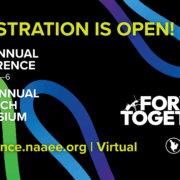
Registration Now Open for the NAAEE 2025 Conference and Research Symposium

The North American Association for Environmental Education (NAAEE) is excited to announce that registration is now open for the 2025 NAAEE Annual Conference and Research Symposium, taking place online from October 30 to November 6, 2025.

This year’s theme, “Forward Together,” invites educators, researchers, and changemakers from around the world to explore how environmental education can help build a more collaborative, resilient, and equitable future.

A Global Gathering for Environmental Educators

The NAAEE 2025 Conference and Research Symposium will bring together hundreds of participants for an inspiring virtual experience that celebrates learning, community, and action. With more than 200 sessions, including keynote addresses, workshops, symposium panels, and discussions, the event will highlight innovative strategies to advance environmental literacy, foster civic engagement, and strengthen connections between people and the planet.

Participants will have the opportunity to:

  • Engage in rich conversations and interactive sessions with leading voices in environmental education.

  • Explore practical tools and strategies to enhance teaching, research, and community engagement.

  • Connect and network with a diverse global community of educators, students, and practitioners.

Accessible and Inclusive for All

NAAEE is committed to making the 2025 virtual experience accessible and inclusive by offering reduced registration rates for anyone who needs them—no application required.

Event Details

  • Research Symposium: October 30, 2025

  • Annual Conference: November 3–6, 2025

  • Location: Online

Learn more, explore the full program, and register today at conference.naaee.org