Tag Archive for: 13th weec

Discover the meaning of Gondwana: the name of the 13th WEEC Congress

Gondwana – Reconnecting Resilient Cultures: a unifying theme for the 13th World Environmental Education Congress

The 13th World Environmental Education Congress (WEEC) in Australia embraces the powerful and unifying theme of Gondwana, highlighting deep geological, ecological, and cultural interconnections across continents. This concept not only bridges ancient histories but also fosters dialogue on environmental education and sustainability in a globally interconnected world.

A shared heritage across continents

Gondwana once united Africa, Antarctica, Arabia, Australia, India, Madagascar, South America, and Zealandia, along with their surrounding oceans and seas. Today, this shared geological history serves as a reminder of the deep-rooted connections among these regions, extending beyond physical landscapes to the cultural and ecological systems that have thrived for millennia.
The theme is strongly supported by Whadjuk Noongar stakeholders, the traditional custodians of the land around Perth, Western Australia. Their endorsement underlines the significance of Indigenous perspectives in fostering environmental awareness and resilience.

Resilient cultures and traditional knowledge

The phrase “Resilient Cultures” acknowledges and respects the enduring legacies of First Nations peoples across the Southern Hemisphere and beyond. Gondwana, originally a Sanskrit term—where “Gond” refers to a Dravidian ethnic group and “vana” means forest—illustrates the longstanding relationship between people and nature. The Whadjuk Noongar people have expressed strong support for this terminology, recognizing the global importance of language preservation and Indigenous knowledge.
By reconnecting ancient cultures and ecosystems, the Congress aims to emphasize the importance of integrating Indigenous wisdom with contemporary environmental science. This approach fosters a more holistic understanding of sustainability and aligns with WEEC’s goal of promoting interdisciplinary knowledge and collaboration.

Learning from the past to shape the future

Gondwana serves as an inspiration for addressing modern environmental challenges by revisiting ancient wisdom and reinterpreting it in contemporary contexts. This philosophy resonates with Indigenous communities who advocate for drawing upon historical knowledge systems to develop sustainable solutions for the future.
The WEEC recognizes that the legacy of Gondwana underscores the necessity for global cooperation. By fostering eco-citizenship, multicultural respect, and a commitment to biodiversity conservation, the Congress aims to strengthen environmental education as a tool for promoting peace and sustainability worldwide.
As delegates from around the world gather to discuss pressing environmental concerns, Gondwana stands as a symbol of unity—reminding us that the challenges we face today can be better understood and tackled through collective efforts and a renewed appreciation for ancient, resilient cultures.

We remind you that the 13th WEEC Congress will take place from September 21 to 25, 2026, in Perth, Australia. Visit the website weec2026.org and subscribe to the newsletter to stay updated. Join our network for a more sustainable future and a global connection among experts and enthusiasts in the field.

The crucial role of indigenous voices at COP16 and beyond

by Jason J. Pitman

The conversations at United Nations Biodiversity Conference (CBD COP16) in Cali, Colombia, held in October 2024, provided a powerful lens for the world to engage with the invaluable contributions of Indigenous communities to global environmental discourse. Through both formal, like those within the high-level discussions in the Blue Zone, and informal spaces curated and the dynamic community-based exchanges in the Green Zone, Indigenous voices echoed a collective call for the decolonisation and indigenisation of environmental education. This call emphasises the need to integrate Indigenous knowledge systems into educational frameworks to address global environmental challenges in a more holistic and inclusive manner.

At COP16, Indigenous leaders and activists were not mere bystanders to the discussions. They were, and have always been, key voices in the ongoing conversation about climate change, biodiversity loss, and sustainable environmental practices. Within the Blue Zone, formal panels offered a space for political and social commentary, where Indigenous perspectives shaped discussions on climate justice, environmental degradation, and sustainability. The stories shared in these panels brought attention to the long-standing relationship Indigenous peoples have with their lands and the urgent need for policies to respect and protect Indigenous territories, resources, and knowledge.

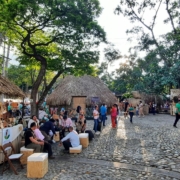
In the Green Zone, the energy shifted from formal discussions to grassroots, community-driven action. Here, a vibrant exchange of ideas took place, where Indigenous groups, community activists, and allies demonstrated how traditional ecological knowledge (TEK) is being applied in real-world contexts to solve environmental issues. These informal spaces underscored the relevance of Indigenous ways of knowing, seeing, and interacting with the environment. Evoking a deep connection between culture and biodiversity as a complex, living system to be nurtured and respected. The Green Zone’s emphasis on community engagement brought to the forefront the lived realities of Indigenous peoples and their innovative solutions to both local and global environmental challenges. Many of these conversations were candid and unfiltered, and while it is not my place to fully share those personal stories, one powerful message was repeated time and again. Indigenous women are leading the charge for biodiversity conservation, and it is time for all men to step aside and allow them to lead the way.

After two weeks of negotiations, delegates at COP16 reached a significant agreement to create a subsidiary body to include Indigenous peoples in future decision-making on nature conservation. This development marks an important step forward in the ongoing movement to recognise the critical role of Indigenous communities in protecting land and combating climate change. The decision underscores the growing recognition of Indigenous knowledge and leadership in environmental stewardship.

Following these efforts is the global call to also reclaim, revolutionise, decolonise, and indigenise education for the betterment of biodiversity. This is a pressing necessity in a world increasingly confronted with the devastating effects of climate change, loss of biodiversity, and environmental degradation. To address these crises, environmental education must evolve to meaningfully incorporate and acknowledge the wisdom and practices passed down through generations of Indigenous peoples. This process of decolonising and indigenising curricula and pedagogy involves more than just acknowledging Indigenous knowledge, it requires a fundamental shift in the way we think about education itself.

It is a privilege to learn from Indigenous knowledge systems as they are deeply rooted in millennia of observation, cultural practices, and spiritual beliefs. These systems offer invaluable insights into sustainable living and environmental stewardship. Often holistic, they emphasise the interconnectedness of all living beings, the importance of community, and the reciprocity between humans and nature. Yet, it is essential to recognise the wisdom Indigenous peoples share is not without its cost. Historically, their knowledge has been extracted without adequate recognition or compensation, and the economic payback for such contributions has been minimal. By embedding Indigenous knowledge and approaches into educational frameworks, we not only broaden the scope of environmental education but also promote a more inclusive and equitable approach to learning. Such approaches must honour the deep value of these contributions by ensuring Indigenous communities are compensated fairly and respected for revolutionising such educational frameworks.

Looking ahead, the 13th World Environmental Education Congress (WEEC) 2026, to be held in Western Australia, provides a timely and symbolic backdrop for furthering the international discourse on the importance of Indigenous voices in environmental education. Western Australia is home to a rich diversity of First Nations peoples whose deep knowledge of the land, seas, and skies stretches back tens of thousands of years. The inclusion of Indigenous perspectives in the 13th WEEC 2026 agenda will allow for a meaningful exchange of ideas on how to transform environmental education into a more inclusive, culturally relevant, and effective system for addressing global challenges.

Indigenous knowledge is particularly crucial in the Global South, where many of the world’s most vulnerable communities reside. As we move forward in addressing the environmental crises facing our world, it is crucial we not only hear Indigenous voices but also respect and integrate their knowledge into formal and in-formal education systems. Incorporating Indigenous perspectives in environmental education, from the classroom to the field, is not just a moral imperative. it is a critical step toward achieving true sustainability. As the world departs from COP16, and as we progress the next two years towards the 13th WEEC 2026, let us listen, learn, partner, and act upon the call of Indigenous peoples to shape a better world for future generations.

Education, youth empowerment, and global partnerships at the heart of biodiversity action

by Jason J. Pitman

As the world continues to confront the urgent challenges of biodiversity loss and environmental degradation, the importance of education as a key driver for change has never been clearer. At 2024 United Nations Biodiversity Conference (CBD COP16), held in Cali, Colombia in October, the global community came together to reaffirm the vital role of education in advancing the conservation goals outlined in the Kunming-Montreal Global Biodiversity Framework. With an eye toward 2026, this momentum will carry forward into the 13th World Environmental Education Congress (WEEC), hosted in Perth, Western Australia, where key themes around transformative educational approaches will be explored.

On Wednesday, 23rd October, the spotlight at COP16 was firmly on education, with a dedicated Education Day at the Kunming-Montreal Global Biodiversity Framework Pavilion. This event responded directly to the May 2024 request from the Convention on Biological Diversity’s Subsidiary Body on Implementation, who called for a Global Plan of Action for Education on Biodiversity. The day brought together over a hundred education experts, leaders, and importantly young people, from across the globe to discuss the essential frameworks, activities, and partnerships required to advance biodiversity education at local and global levels.

The Education Day underscored a clear message. Education is not a luxury, but a fundamental tool for achieving global biodiversity targets. The discussions highlighted how embedding education into national biodiversity strategies, curricula, and policies will be crucial to ensuring the long-term success of biodiversity conservation efforts. From formal to non-formal education, the call was made for all systems to integrate biodiversity education across every level of society, from classrooms to community spaces.

One of the most powerful moments of the day was the release of the Global Child Biodiversity Declaration, crafted by youth delegates from over 25 countries. The Declaration, produced as part of the EducationNatureNexus (#ENN) program run by the Centre for Global Education. In preparation for the Declaration, over 600 children aged 6-18 from around the world participated in a Global Student Environment Survey, sharing their personal experiences with nature, environmental education, and government policies. This Declaration represents a powerful call to action for the world to listen, and act upon, youth voices in the fight for biodiversity preservation. In their declaration, youth demanded government policies ensure every child’s right to high-quality biodiversity education, integration of Indigenous knowledge, and transformative curricula to encourage hands-on, nature-based learning.

The declaration also highlighted the rising tide of eco-anxiety among young people, with nearly 80% of students globally report feeling a deep concern for the planet’s future. But this also demonstrates their readiness to engage in transformative solutions as witness by the young people who spoke clearly and confidently in announcing the Declaration to an international audience. The energy and passion of these young changemakers will form the foundation for future efforts, including the call to action for education to become central in achieving the ambitious biodiversity targets set by COP16.

A major takeaway from the Education Day discussions was the power of partnerships. Educators, governments, organisations, and youth must work together, pooling resources and knowledge to drive the educational reforms needed for biodiversity conservation.

This spirit of collaboration will carry over into the 13th World Environmental Education Congress in 2026, where participants will continue to explore how partnerships can foster interdisciplinary and transdisciplinary approaches in education, enabling global cooperation for a more sustainable and biodiverse future. The next WEEC will be a platform for showcasing successful examples of cross-sector partnerships in education, and for inviting global partners to unite behind shared goals of educational transformation.

As momentum builds, the 13th WEEC 2026 in Perth will focus on two critical international calls to action address the needs identified at COP16. The first call, Empowering Learners as Change Agents will seek to inspire educational reforms to build agency in learners, enabling them to develop critical thinking, problem-solving, and leadership skills to actively participate in societal change and tackle environmental challenges. As witness in the Declaration prepared and voiced by international youth. The second call, Interdisciplinary Approaches for a Sustainable Future, will continue to amplify the need for education systems to integrate interdisciplinary and transdisciplinary approaches, breaking down silos between subjects, and fostering a holistic understanding of the interconnectedness of biodiversity, climate, and sustainable development. Through these actions, communities will be better equipped to respond to the multifaceted challenges of the biodiversity crisis.

As COP16 draws to a close, we have two years in preparation for the 13th WEEC 2026. With this, there is a growing call for global partners to get involved and continue in these critical conversation. Governments, NGOs, educational institutions, and the private sector all have a role to play in advancing education for biodiversity. However, perhaps the most important partners are young people. They are the future stewards of the planet, and their voices must be heard in every conversation about environmental education and action.

The Youth Environmental Education Congress 2026 will take place in conjunction with WEEC, and its sole-purpose is to amplify the diverse youth voices in environmental education. Further reigniting the need and call for young people to globally unite with educators, policymakers, and thought leaders to explore intergenerational wisdom and create space for youth-led solutions including:

  • Bridging the gap between youth and elders for educational transformation.
  • Challenging conventional educational structures and embracing ecological perspectives.
  • Ensuring inclusivity and amplifying marginalised or under-represented voices in educational spaces.
  • Pioneering change into the broader sustainability agenda.

As the global community continues critical conversations outside of the confines of conference walls, the action from COP16 is clear: we must prioritise education for biodiversity conservation, empower youth to take a leading role, and foster collaborative partnerships to achieve shared environmental goals. The declaration from youth at COP16 provides a powerful roadmap for the future of education and biodiversity, and the work will continue at 13th WEEC 2026, where we will collectively chart the path toward a more sustainable and biodiverse world. Therefore, we invite global partners, educational institutions, youth organisations, and environmental leaders to join us in this transformative journey. Together, we can create an educational ecosystem, one empowering learners, fosters collective action, and delivers tangible solutions for the planet’s future.

Perth selected as host for 13th World environmental education congress (WEEC) in 2026

The World Environmental Education Congress (WEEC) Permanent Secretariat and the Australian Association of Environmental Education (AAEE) announced Perth as host for the 13th World Environmental Education Congress (WEEC) in 2026.

Following the resounding success of the 12th World Environmental Education Congress (WEEC) held in Abu Dhabi in January and February 2024, the WEEC Permanent Secretariat takes great pride in announcing that Wadjuk Noongar Country – Perth, Western Australia – has been selected as the host city for the 13th WEEC in 2026.

The WEEC Permanent Secretariat will partner with the Australian Association of Environmental Education (AAEE) to bring this premier international congress dedicated to the progression of environmental education and the advancement of education for sustainability worldwide.

“After twelve world congresses, the environmental education community starts a journey towards new goals from Australia”, said Mario Salomone, WEEC Secretary-General. “The environmental approach to the knowledge is a key for a paradigm shift and must be more and more at the centre of the formal and non-formal education. The global project on learning implemented in close collaboration with the Club of Rome will bring to the congress in Perth updated data, inspiring thoughts, and new mindfulness”.

The WEEC serves as a platform for global dialogue, learning, and exchanging ideas on environmental education programs. “The work we are doing in Australasia on environmental education and education for sustainability positions us as a leading destination,” said Dr Lisa Siegel, President of AAEE. “We welcome environmental educators locally and from around the world to attend WEEC 2026 to benefit from international discourse and showcasing best practices.”

AAEE Vice Presidents Dr Jennifer Pearson and Mr Jason Pitman, both in Western Australia, will co-chair the organising committee for the 13th WEEC. “We are thrilled to showcase Western Australia’s rich environmental and cultural heritage to delegates from around the world,” said Dr Pearson. “From sustainable initiatives in early learning to the growing impact of place-based education efforts, the 13th WEEC presents a unique opportunity to share our knowledge and learn from our global counterparts.”

“The 13th WEEC in 2026 will facilitate stronger connections between countries in the Oceania region and beyond,” added Mr Pitman. “By sharing our responses to the climate crisis and exchanging international perspectives on living more sustainably, we aim to foster collaboration and galvanise collective action in the global community.”


Information and updates

For further information and updates on the 13th WEEC 2026, please visit:

www.weecnetwork.org or www.aaee.org.au

Alternatively, please get in touch with the Local Organising Committee via:

Dr Jennifer Pearson, Co-chair, jopearson189@gmail.com

Mr Jason Pitman, Co-Chair, jason.j.pitman@gmail.com

And with the international Permanent Secretariat:

secretariat@weecnetwork.org