
The crucial role of indigenous voices at COP16 and beyond
by Jason J. Pitman
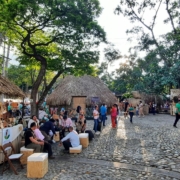
The conversations at United Nations Biodiversity Conference (CBD COP16) in Cali, Colombia, held in October 2024, provided a powerful lens for the world to engage with the invaluable contributions of Indigenous communities to global environmental discourse. Through both formal, like those within the high-level discussions in the Blue Zone, and informal spaces curated and the dynamic community-based exchanges in the Green Zone, Indigenous voices echoed a collective call for the decolonisation and indigenisation of environmental education. This call emphasises the need to integrate Indigenous knowledge systems into educational frameworks to address global environmental challenges in a more holistic and inclusive manner.
At COP16, Indigenous leaders and activists were not mere bystanders to the discussions. They were, and have always been, key voices in the ongoing conversation about climate change, biodiversity loss, and sustainable environmental practices. Within the Blue Zone, formal panels offered a space for political and social commentary, where Indigenous perspectives shaped discussions on climate justice, environmental degradation, and sustainability. The stories shared in these panels brought attention to the long-standing relationship Indigenous peoples have with their lands and the urgent need for policies to respect and protect Indigenous territories, resources, and knowledge.
In the Green Zone, the energy shifted from formal discussions to grassroots, community-driven action. Here, a vibrant exchange of ideas took place, where Indigenous groups, community activists, and allies demonstrated how traditional ecological knowledge (TEK) is being applied in real-world contexts to solve environmental issues. These informal spaces underscored the relevance of Indigenous ways of knowing, seeing, and interacting with the environment. Evoking a deep connection between culture and biodiversity as a complex, living system to be nurtured and respected. The Green Zone’s emphasis on community engagement brought to the forefront the lived realities of Indigenous peoples and their innovative solutions to both local and global environmental challenges. Many of these conversations were candid and unfiltered, and while it is not my place to fully share those personal stories, one powerful message was repeated time and again. Indigenous women are leading the charge for biodiversity conservation, and it is time for all men to step aside and allow them to lead the way.
After two weeks of negotiations, delegates at COP16 reached a significant agreement to create a subsidiary body to include Indigenous peoples in future decision-making on nature conservation. This development marks an important step forward in the ongoing movement to recognise the critical role of Indigenous communities in protecting land and combating climate change. The decision underscores the growing recognition of Indigenous knowledge and leadership in environmental stewardship.
Following these efforts is the global call to also reclaim, revolutionise, decolonise, and indigenise education for the betterment of biodiversity. This is a pressing necessity in a world increasingly confronted with the devastating effects of climate change, loss of biodiversity, and environmental degradation. To address these crises, environmental education must evolve to meaningfully incorporate and acknowledge the wisdom and practices passed down through generations of Indigenous peoples. This process of decolonising and indigenising curricula and pedagogy involves more than just acknowledging Indigenous knowledge, it requires a fundamental shift in the way we think about education itself.
It is a privilege to learn from Indigenous knowledge systems as they are deeply rooted in millennia of observation, cultural practices, and spiritual beliefs. These systems offer invaluable insights into sustainable living and environmental stewardship. Often holistic, they emphasise the interconnectedness of all living beings, the importance of community, and the reciprocity between humans and nature. Yet, it is essential to recognise the wisdom Indigenous peoples share is not without its cost. Historically, their knowledge has been extracted without adequate recognition or compensation, and the economic payback for such contributions has been minimal. By embedding Indigenous knowledge and approaches into educational frameworks, we not only broaden the scope of environmental education but also promote a more inclusive and equitable approach to learning. Such approaches must honour the deep value of these contributions by ensuring Indigenous communities are compensated fairly and respected for revolutionising such educational frameworks.
Looking ahead, the 13th World Environmental Education Congress (WEEC) 2026, to be held in Western Australia, provides a timely and symbolic backdrop for furthering the international discourse on the importance of Indigenous voices in environmental education. Western Australia is home to a rich diversity of First Nations peoples whose deep knowledge of the land, seas, and skies stretches back tens of thousands of years. The inclusion of Indigenous perspectives in the 13th WEEC 2026 agenda will allow for a meaningful exchange of ideas on how to transform environmental education into a more inclusive, culturally relevant, and effective system for addressing global challenges.
Indigenous knowledge is particularly crucial in the Global South, where many of the world’s most vulnerable communities reside. As we move forward in addressing the environmental crises facing our world, it is crucial we not only hear Indigenous voices but also respect and integrate their knowledge into formal and in-formal education systems. Incorporating Indigenous perspectives in environmental education, from the classroom to the field, is not just a moral imperative. it is a critical step toward achieving true sustainability. As the world departs from COP16, and as we progress the next two years towards the 13th WEEC 2026, let us listen, learn, partner, and act upon the call of Indigenous peoples to shape a better world for future generations.
 The World Bank estimates that there are about 370 million Indigenous people living worldwide in over 90 countries, accounting for 4,8% of the world’s population. Almost 80 percent of these are located in Asia and more than one-third in China alone. This type of ancestral knowledge and expertise on how to adapt, mitigate and reduce disaster risks has been internationally recognized as a support for the modern methods to cope with the imminent effects of climate change. Further, indigenous education can be an example of what a sustainable life means: a non-anthropocentric experiential transmission of coexistence with nature, based on mutual respect and a deep sense of belonging. Any knowledge (epistemology) can “be useful or useless, politically salient or meaningless, socially relevant or irrelevant, empirically testable or irrefutable, ideologically open or blind, without reference to whether it is indigenous or scientific” (Arun Agrawal). However, conitnuing pressure to maintain living standards in the industrial countries imply devastating socio-economic and territorial changes for indigenous peoples all over the world. The Their livelihoods are contaminated by raw material extraction and deforestation processes, and actions that force them to enter into market dynamics as the only way to survive and protect their territory.
 The Equator Prize 2019 will be awarded to outstanding community and indigenous initiatives that are advancing nature-based solutions for local sustainable development. Each winning group will receive USD 10,000 and will be invited to participate in a series of policy dialogues and special events during the United Nations General Assembly and the Secretary-General’s Climate Summit in New York in September 2019, culminating in a high-level award ceremony at the beginning of Climate Week.
 For more than two decades, Chile’s indigenous Diaguita Huascoaltinos have faced the powerful extractive model that has emerged in Chile. Since 2000, this community has resisted attempts to locate Pascua Lama, a Chile-Argentina binational mining project, the Canadian gold company Barrick Glod Corporation. This project was initially approved in 2000, following 10 years of exploration.