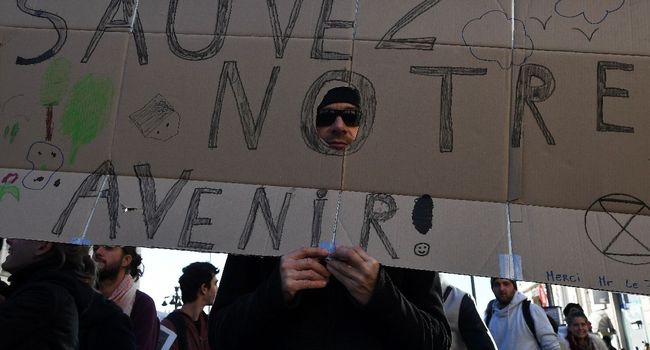
 Cet été Nicolas Hulot le ministre de l’écologie, a démissionné du gouvernement en disant en direct à tous les français sur France inter : « … je ne veux plus me mentir… ». Comme quelqu’un qui y croyait avant et qui n’y croit plus maintenant. Parce que c’est vrai, tout est là pour qu’on y croie. Les chiffres et les cris d’alerte des scientifiques, les paroles des politiques, les textes signés lors des grandes conférences internationales, tout est là pour qu’on croie, tant le péril est évident, qu’on va faire quelque chose. Alors forcément un temps on y croit… Et puis la réalité s’impose et la prise de conscience vient. Le constat est terrible. « Ils » ne font rien. Il n’y a pas de « nous ». Ce serait stupide d’y croire plus longtemps. Des milliers d’enfants dans des centaines de villes dans le monde comme Greta Tunberg à Stockholm se mettent en grève pour le crier.
Gilets jaunes
Depuis la fin de l’année 2018 et maintenant début 2019 la France est secouée par une crise très grave qui se traduit par de grandes violences et de grandes inquiétudes. Les gilets jaunes en sont la marque. Cela peut sembler étrange mais quand on réfléchit un peu au chemin parcouru ces quarante dernières années, nous avons avec l’histoire de l’éducation à l’environnement, une clé de compréhension de ce désespoir et de cette rage qui monte.
Tous ensemble
Depuis au moins quarante ans en France les acteurs de l’éducation à l’environnement dans leur diversité s’organisent entre eux afin de faire avancer leur pratique éducative dans le corps social français. Dans leur cheminement ils ont créé de nombreuses associations qui sont autant de corps intermédiaires. Le Réseau Ecole et Nature, les GRAINE (Groupe Régional Animation Initiation Nature Environnement) et le Collectif Français pour l’Education à l’Environnement vers un Développement Durable (CFEEDD) sont les plus connus. Après des assises nationales qui ont réuni en 2000, 2009 et 2013 des milliers de personnes toutes parties prenantes, dont des ministres, des acteurs associatifs, des fonctionnaires des collectivités et de l’État, des acteurs syndicaux, des acteurs des entreprises et de l’université … des espaces de concertation pour l’EEDD ont été créés. Tout cela a été porté à bout de bras par les acteurs de la société civile et quelques fonctionnaires éclairé(e)s.
Petite pousse pleine d’espérance qui faute de soin meurt
Mais l’État, comme la plupart des collectivités n’attache pas d’importance à cette organisation des acteurs. A moins qu’il la redoute. On peut dire que les autorités publiques, qu’elles soient nationales ou régionales ou encore plus locales, le plus souvent, il y a heureusement des exceptions, se désintéressent de l’EEDD et la laisse volontiers livrée à elle-même. Il a fallu aux acteurs de la société civile française déployer une énergie considérable pour créer des organisations, faire des assises, organiser le forum international francophone Planet’ERE 2 en 2001 à l’UNESCO avec 1500 participants de 42 pays ! Créer une ONG internationale francophone, s’impliquer dans le World Environnmental Education Congress (WEEC)… Ils n’auront pas de soutien ou si peu, en tout cas jamais à la hauteur des enjeux.
Petite plante spontanée qui pousse pleine de vigueur et après quelques temps meurt sur son rond point privée d’eau quand elle a soif, d’ombre quand il faut de l’ombre, de soleil quand il faut de la lumière, sans soin dans l’indifférence de tous.
Sans corps intermédiaires rien ne va
Ce mouvement des gilets jaunes qui s’est déclenché en novembre 2018 en France et se poursuit avec une grande vigueur en janvier 2019 et qui secoue la France est le symptôme d’un dérèglement profond dans la société française. Nous sommes face à l’absence de corps intermédiaires entre l’autorité publique et le citoyen.
Or sans corps intermédiaires rien ne va. Les associations, les syndicats, les partis politiques… sont des corps intermédiaires, or pour de multiples raisons, ceux en place depuis des années sont affaiblis, ils disparaissent, des nouveaux n’arrivent pas à naitre. Ils sont considérés soit comme sans valeur ou comme contre pouvoir, éventuellement un jour dangereux, donc à éliminer.
Sans eux pourtant l’individu se retrouve sans aucun lien avec l’autorité publique, sans lien avec son prince, sauf, la loi qui s’impose à lui, l’impôt qui s’impose à lui, sauf des média publics dont il doute, sauf un pauvre bulletin de vote qui tous les ans semble peser moins lourd. Il n’a en réalité aucune prise, il ne sait comment agir pour que les choses aillent un peu mieux à son goût dans la société. Il ressent une impuissance incompatible avec le statut de citoyen qu’on lui promet par ailleurs.
« Citoyen » un statut historique et qui a du sens dans l’âme française. Oui, il passerait bien au jaune le gilet de l’éducateur à l’environnement en France. Il avait toutes les raisons de croire que « nous » allions faire quelque chose, l’éducateur à l’environnement. Oui « nous » société civile et autorités publiques locales, régionales et nationales main dans la main, et même les entreprises avec, oui le secteur marchand, dans le dialogue, dans la concertation, dans le respect mutuel, la coconstruction… et rien. On ne peut plus se mentir. Rien.
Quand « essentiel » ne veut rien dire
Ils ont dit les Etats dés 1972 à Stockholm (déjà !) dans le principe 19 : « Il est essentiel de dispenser un enseignement sur les questions d’environnement aux jeunes générations aussi bien qu’aux adultes… », Ils l’ont répété à Rio en 92 en disant dans le principe 10 : « La meilleure façon de traiter les questions d’environnement est d’assurer la participation de tous les citoyens concernés, au niveau qui convient. » et encore lors de toutes les conférences jusqu’à l’accord de Paris de la COP 21 qui le répète en 2015 dans son article 12… et rien… pas d’effet, pas d’action… « Essentiel » ne veut rien dire ! Une ministre même, Delphine Batho, devant 1200 personnes en 2013 à Lyon lors des troisièmes assises a dit que l’EEDD devait devenir une « grande cause nationale » et rien… Ils ont unilatéralement effacé le mot « environnement » et imposé « l’éducation au développement durable » qui venait du haut, concept qui a enlevé de la clarté, provoqué de la fragmentation et fait perdre des heures de palabres pour rien. Mot qu’aujourd’hui on n’entend plus nulle part. Ils ont créé un observatoire de l’éducation à l’environnement en 2004, comme préconisé dans le Plan National d’Action créé par la société civile en 2000, cet observatoire n’a jamais rien produit et n’existait plus en 2006. Pendant près de dix ans animée par la société civile, une réelle concertation autour de l’EEDD a existé entrainant jusqu’à six ministères, elle est morte aujourd’hui de n’avoir pas été soutenue alors que, ce qu’était cette concertation et ce qu’elle faisait, était dans la droite ligne des recommandations de l’UNESCO soutenu par la France. Mais qu’elle France ? Une France qui acquiesce quand des barons régionaux inondent les chasseurs de subventions et assèchent encore plus le tissu de ceux qui aux cotés de la jeunesse et de tous les citoyens s’engagent pour la faune, la flore, la fin du réchauffement… Ils portent atteinte au sens des mots.
La maison brûle.
Comme l’ancien ministre, les éducateurs à l’environnement français ne peuvent plus se mentir eux non plus. On les a trahis, c’est la réalité, on pourra les traiter de naïf, de candide, la réalité c’est qu’ils ont cru en l’existence d’un prince bienveillant et à l’écoute du peuple, or rien, jamais rien. Donc forcement la colère monte, la rage vient, on se rend compte qu’on s’est bien fait avoir, on nous a promenés en bateau. L’UNESCO dit que les Etats devraient avoir des plans d’action pour l’EEDD, la France n’en a pas et elle s’en fout, mieux, cela l’arrange. Comment ne pas finir par le croire que ça l’arrange. Comme l’arrange le fait de ne plus donner aucun moyen aux associations qui sont vues plus comme des contre pouvoirs que comme des forces de propositions constructives. Alors forcément la situation se tend. Mais il y a des français qui ne se contentent pas de ça et pas seulement dans l’éducation à l’environnement. Ils sont constructifs, ils connaissent leur affaire, ils sont sincères et rigoureux, on se moque d’eux, ils agiront quand même autrement, localement sans doute, ils ne peuvent eux regarder ailleurs quand « la maison brûle »
Insupportable pour celui qui aime son pays.
Maintenant c’est nous tous qui ne pouvons plus nous mentir. Voilà maintenant une immense colère qui s’exprime, voilà qu’on dit que pour nous « essentiel » ça a du sens, voilà qu’on dit que « participation de tous les citoyens concernés » ça a du sens, voilà qu’on dit qu’on ne veut plus entendre parler de « double discours » mais qu’on dise clairement « mensonge » et « tromperie ». C’est pour ça aussi tous ces gilets jaunes, c’est pour ça aussi ces 2 millions de signatures pour soutenir une action en justice pour le climat « l’affaire du siècle » contre l’Etat français. Il est urgent de réactiver l’éducation à la citoyenneté, l’écart entre le souverain et le citoyen ne peut plus devenir plus grand, il faut agir, cette situation est devenue insupportable pour celui qui aime son pays.
Roland GERARD

 The first one is for a Postdoctoral researcher in sociology with focus on International expert organisations: the School of Humanities, Educational and Social Sciences is seeking a postdoctoral researcher in sociology for a fixed-term appointment.
 SEI (
SEI ( It is possible now to enroll in the open, online course (or MOOC) entitled
  One extra place is available at the
  “I’m interested in the particularity of each Tree – it’s ‘thisness’ (haecceitas)”, claims Canadian land-artist, photographer, and poet Marlene Creates, thus hinting both at the specificity of each singular tree and at the uniqueness of certain species at different latitudes. Literature, among other arts, such as film, photography, the fine arts, is one of those privileged terrains where Trees definitely enter our field of vision, our epistemic knowledge, our sensorial experience. In literary and artistic productions, Trees are ethically and aesthetically called into question (evoked, invoked, iconized, prized, iven attacked), with the aim to identify, describe, or allegorize their singularities and specificities, or to pay homage to their material, literal, cultural, ethnic, and symbolic meaning through a variety of textualities, including the new media.
 The Equator Prize 2019 will be awarded to outstanding community and indigenous initiatives that are advancing nature-based solutions for local sustainable development. Each winning group will receive USD 10,000 and will be invited to participate in a series of policy dialogues and special events during the United Nations General Assembly and the Secretary-General’s Climate Summit in New York in September 2019, culminating in a high-level award ceremony at the beginning of Climate Week.
 Cet été Nicolas Hulot le ministre de l’écologie, a démissionné du gouvernement en disant en direct à tous les français sur France inter : « …
 On the 21st of November the Seas, Rivers, Islands and Coastal Areas Intergroup (Searica) met with MIO-ECSDE and the informal Circle of Mediterranean Parliamentarians for Sustainable Development (COMPSUD) at the European Parliament in Brussels. This was a unique occasion where Members of the European Parliament and Members of Parliament of non-EU countries came together with marine litter experts, environmental NGOs, journalists and other key stakeholders to explore the next steps in achieving a litter-free Mediterranean Sea. The event was attended by some 65 participants from 20 or so countries.
  For a long time we have known that plastic in the ocean is a problem; we know the causes of it deleterious effects on the marine environment.
