ArtWay: Education for a Harmonious and Responsible Humanity

In 1972, The Limits to Growth warned of the potential collapse of human civilization, and in 1979, No Limits to Learning highlighted the “human gap,” the persistent disparity between our ability to shape reality and our understanding of the consequences of our actions. Today, humanity faces a convergence of crises: climate change, biodiversity loss, social inequalities, polarization, mental health challenges, and spiritual disconnection. The ArtWay method responds to these challenges by offering a transformative educational framework that integrates language learning with music, culture, art, and ethical reflection, fostering emotional intelligence, moral reasoning, creativity, systemic thinking, and a sense of global and planetary responsibility.

ArtWay is an interdisciplinary approach that positions education as a holistic and ethical undertaking. At its core, it recognizes that language and music are structurally and functionally intertwined through rhythm, intonation, melody, and harmonic patterns. By mapping linguistic elements onto musical structures, students experience grammar, phonetics, and vocabulary as multisensory, embodied phenomena. Irregular verbs, syntactic structures, and phonemes acquire rhythm, pulse, and melodic resonance, enhancing memory, intuitive understanding, and creative engagement. Music becomes a conduit for deeper cognitive, emotional, and ethical development. Neuroscientific research confirms that music activates both hemispheres of the brain, harmonizes cognitive processes, strengthens memory, and supports emotional regulation, empathy, and collaborative problem-solving.

The method extends beyond conventional pedagogy by incorporating intercultural immersion. Students engage with musical traditions, literature, and linguistic expressions from diverse cultures—from West African drumming patterns to Eastern tonalities, from Indigenous oral storytelling to European classical harmonics. Through this exploration, learners cultivate empathy, cultural literacy, and ethical awareness, gaining a deeper understanding of the world’s diversity while developing a sense of shared human responsibility. ArtWay transforms language learning into a cultural dialogue in which every lesson becomes a journey through the histories, traditions, values, and ethical frameworks of different peoples, fostering global citizenship and mutual respect.

ArtWay also places strong emphasis on moral and ethical education. Students are encouraged to reflect on universal values, social responsibility, environmental stewardship, and social justice through the combined lens of music and language. By internalizing ethical principles alongside artistic and linguistic skills, learners develop the capacity for critical judgment, compassion, and action-oriented reasoning. Integrating aesthetic experience with cognitive learning nurtures not only intellectual abilities but also emotional resilience, ethical discernment, and spiritual awareness. Music becomes a medium for exploring the moral dimensions of human experience—from cooperation and empathy to responsibility for future generations.

Practical applications of ArtWay demonstrate its transformative potential. Since 2016, more than 1,500 children aged 4 to 15 have learned English through this method at the MusicEnglish Club. Students master the language more quickly and retain knowledge more effectively than in conventional settings, while simultaneously developing creativity, emotional awareness, intercultural competence, and collaborative skills. For example, children practice pronunciation and intonation through jazz improvisation, grammatical structures through choral recitation, and vocabulary through songs drawn from diverse cultural traditions. Each lesson integrates historical, social, and artistic context, turning language learning into a multidimensional exploration of human expression and societal values.

ArtWay aligns closely with the vision of global organizations and research initiatives promoting transformative education. It draws on contemporary findings in neuroeducation, cognitive science, emotional intelligence, sustainability education, and arts-based learning to cultivate students capable of addressing complex global challenges. By embedding systemic thinking, creative problem-solving, and cross-cultural dialogue into language learning, ArtWay equips learners with practical tools for social innovation, conflict resolution, ecological stewardship, and peacebuilding. Its principles resonate with the United Nations Sustainable Development Goals, UNESCO’s initiatives for intercultural dialogue, and WAAS’s planetary vision for ethical and holistic education.

The method is inherently future-focused and innovative. ArtWay envisions a global network of certified educators, an online platform for worldwide access, methodological publications, and advanced digital resources integrating AI, immersive media, and adaptive learning technologies. These tools enhance personalized learning while preserving the method’s emphasis on creativity, ethics, and cultural depth. ArtWay encourages students to participate in collaborative projects, global musical exchanges, and intercultural workshops, fostering a sense of planetary citizenship and active engagement with pressing societal issues. It promotes the integration of traditional knowledge, Indigenous wisdom, and contemporary arts to create culturally rich, contextually sensitive, and globally relevant learning experiences.

Ultimately, ArtWay bridges the human gap by connecting knowledge with action. It nurtures learners who are linguistically proficient, creatively empowered, emotionally intelligent, ethically grounded, culturally literate, and globally responsible. By fostering deep engagement with music, art, culture, and moral reasoning, ArtWay transforms education into a tool for building sustainable societies, intercultural understanding, and peaceful coexistence. It demonstrates that education can simultaneously cultivate cognitive excellence, emotional depth, ethical integrity, and social impact, preparing learners to navigate and shape the complex, interconnected world of the 21st century.

ArtWay represents a new paradigm of education in which artistic expression, intercultural dialogue, moral reflection, cognitive development, and global responsibility converge. It empowers learners to explore the richness of human cultures, engage creatively and ethically with societal challenges, and contribute actively to planetary stewardship, social justice, and human unity. By integrating music, language, culture, and ethics, ArtWay exemplifies the potential of education as a transformative force for personal growth, collective innovation, and the co-creation of a sustainable and harmonious global future.

The Future of Learning and 13th WEEC 2026: What Comes Next?

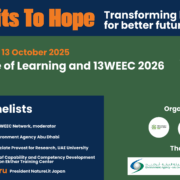
Watch the session “The State of Learning and 13WEEC 2026”, a key moment dedicated to the future of environmental education and the evolving global landscape of learning for sustainability. The panel took place at the IUCN World Conservation Congress in Abu Dhabi on October 13th, 2025.

The discussion brought together leading voices in environmental learning: Bianca La Placa (WEEC Network), who moderated the session; Richard Perry (Environment Agency Abu Dhabi); Rami Beiram (Associate Provost for Research, UAE University); Toni Chalah (Head of Capability and Competency Development, Ekthar Training Center); and Kotoko Yadomaru (President, NatureLit Japan).

Throughout the conversation, panelists explored emerging priorities in sustainability education, new competencies needed for a rapidly changing world, and the role of global partnerships in shaping the 13th World Environmental Education Congress (3WEEC) 2026. They highlighted the importance of nature-based learning, cross-sector collaboration, and innovative research as essential drivers of transformative environmental action.

The session was organized by WEEC, The Club of Rome, and The Fifth Element, with the support of the Environment Agency Abu Dhabi, and hosted at the IUCN Nature-based Education Pavilion.

Forest, Climate and Natural Resource Governance

I served as an intern in forest, climate change, environmental, natural resource, and sustainable development law and policy at the African Union Commission, Division of Environment, Climate Change, Natural Resource, Water and Land Management, Department of Rural Economy and Agriculture, in Addis Ababa, Ethiopia. In this role, I contributed to the development, analysis and implementation of African environmental, forest, climate change, natural resource management and sustainable development policies and strategies. My work focused on community-based and participatory approaches to forest, land and water management, including Community-Based Forest Management (CBFM), Joint Forest Management (JFM), Collaborative Forest Management (CFM), Participatory Forest Management (PFM), Social Forestry (SF), Community-Based Natural Resource Management (CBNRM), Community Forestry (CF), Participatory Land Management (PLM), Community-Based Water Resource Management (CBWRM) and related frameworks.

I was involved in technical and legal analysis on forest categorisation and resource assessment, local forest governance, income generation and markets linked to forest resources, forest dependency and the recognition of local and community rights. My tasks also included work on forest management agreements and contracts, gender mainstreaming in forest governance, land-use planning, land tenure, ownership and possession of land and water, as well as broader policy and legal analysis in these domains. I contributed to initiatives such as the Africa Land Policy Initiative, African water policy and strategy implementation (including the African Water Vision for 2025), integrated water and land resource management, and regional, national and local conservation programmes. This included engagement with the African Agriculture Growth Project (AAGP), the Comprehensive African Agricultural Development Programme (CAADP), African food security and livelihood programmes and the Climate-Resilient Green Economy (CRGE) strategy.

My experience also covers the use of Management Information Systems (MIS), Geographic Information Systems (GIS) and Business Information Systems (BIS) for natural resource monitoring (forest, land and water) and biodiversity conservation, national forest programmes and Environmental Impact Assessment (EIA). I contributed to assessments and policy work related to major initiatives such as the Ethiopian Grand Renaissance Dam project on the Nile River, irrigation and drainage development in northern Ethiopia, Nile Basin Initiative programmes, and the Great Green Wall for the Sahara and the Sahel. I worked on issues of rights, contracts, leases, tenure, titles, certificates, rent, management agreements and action plans for forest, land and water, as well as the coherence of continental, regional and national policies with international legal instruments and multilateral environmental agreements.

Furthermore, I engaged with themes of decentralisation and devolution of forest, land and water administration; cross-sector policy coherence; gender mainstreaming in environmental, forest, land and water governance; African forest policy and strategy implementation; climate risk reduction, adaptation and mitigation; and regional and local governance frameworks such as the Lake Tana (Ethiopia) hydroelectric, irrigation and tourism development project and the Akaki River pollution control and conservation roadmap. My work also touched on institutional capacity-building, ICT applications in resource governance, political commitment, data and records management, collective decision-making and adaptive strategies in environmental and natural resource administration.

Drawing on this background, I am strongly motivated and fully prepared to contribute as an active member of the WEEC Network and the Club of Rome.

Beyond the ‘Human Gap’: Transforming Education for Sustainable Futures

Forty-five years after the report No Limits to Learning: Bridging the Human Gap was presented to the Club of Rome in 1979, the debate on educational challenges has returned to centre stage. The new international call No Limits to Hope: Transforming Learning for Better Futures—promoted by the Club of Rome, The Fifth Element, and the WEEC Network—invites us to radically rethink educational paradigms so humanity can address current and future global crises. The “human gap” identified by Aurelio Peccei—i.e., the distance between available knowledge and our ability to translate it into effective practice and policy—remains starkly open. Many educational institutions, anchored to conservative training models, still struggle to incorporate the solutions and skills the scientific community has developed in response to the climate crisis, social inequalities, and technological transformations.

This contribution explores how to bridge this human gap through a theoretical-and-applied approach that integrates sociological, sustainability, and intersectional perspectives. In particular, it analyses the need for systemic change in educational policy and governance, using the European project SUSEDI (SUStainability in EDucational Institutions) as a case study—a concrete example of institutional transformation towards sustainability. The aim is to outline implications and recommendations for future education policies, connecting traditional knowledge and transdisciplinary approaches in the spirit of active, transformative hope for a better future.

Theoretical framework

The proposal is grounded in Education for Sustainability and theories of transformative change. In the spirit of No Limits to Hope, transforming learning for a better future means acting on all aspects of education—paradigms, organisations, methodologies, and programmes—to bridge the gap between our knowledge systems and the mounting challenges facing humanity. In other words, we must move beyond “conservative” education (still predominantly transmissive and disciplinary) towards innovative, systemic education centred on critical thinking, imagination, and collaborative competence—capable of closing the human gap between knowledge and action.

A central element of the framework is an intersectional perspective. Sustainability challenges are intrinsically linked to social justice, gender equity, cultural diversity, and human rights. An intersectional approach recognises that environmental and economic crises affect social groups differently (by gender, ethnicity, class, etc.), and that transformative education must address these intersections to be inclusive and effective. This entails promoting content and practices that integrate climate and social justice, giving voice to perspectives historically marginalised—such as those of Indigenous peoples, local communities, and young activists. It also responds to the need to connect traditional knowledge with transdisciplinary perspectives: much Indigenous and local knowledge offers valuable sustainable solutions, yet often remains at the margins of dominant curricula due to epistemic power imbalances. Overcoming these imbalances requires embracing a plurality of epistemologies—integrating experiential, relational, and community-based learning alongside analytical and formalised learning—so that both scientific and traditional knowledge are valued in educational institutions.

A further theoretical foundation is transformative and systemic learning. Inspired by critical pedagogy and transformative learning theory, Education for a Sustainable Future must go beyond the transmission of knowledge to facilitate shifts in mindsets, values, and behaviours—of individuals and communities alike. In this sense, UNESCO’s Whole Institution Approach (WIA) in Education for Sustainable Development is crucial. A WIA embeds sustainable development across all processes of an educational institution: not only in curricula, but also in management and governance, organisational ethics, active stakeholder engagement (leaders, teachers, students, staff, local community), long-term planning, and continuous monitoring. The school or university becomes a living laboratory of sustainability, aligning daily practices with the principles it teaches (e.g., ecological campus management, participatory decision-making, inclusion and well-being policies). WIA therefore offers a theoretical and operational framework for implementing systemic change across pedagogy, structures, and governance.

Methodology and approach

This contribution adopts an interdisciplinary, qualitative design that combines theoretical analysis with empirical study.

  1. Critical literature review on sustainability education, transformative learning, intersectionality in education, and the Whole Institution Approach, in order to summarise the state of the art and identify the gap between research-based knowledge and prevailing educational practices.

  2. Exploratory case study of the European SUSEDI project as an exemplary instance of systemic transformation in educational institutions. Project documents, public reports, and preliminary outputs will be examined to understand how WIA, transdisciplinarity, and related principles are operationalised, with what challenges, and with what early results.

  3. Transdisciplinary synthesis to derive implications for education policy. Conclusions will blend academic insight with practical experience to offer recommendations relevant to policymakers, educators, and communities.

The SUSEDI analysis follows a sociological-qualitative lens, attending to governance, stakeholder involvement (leadership, teachers, students, external community), organisational change, and effects on educational and decision-making practices. An intersectional lens will ensure attention to equity and inclusion (e.g., whether and how SUSEDI addresses socio-cultural differences across participating schools, and how diverse voices are included in transformation processes).

Case study: the SUSEDI project

The SUSEDI project (Route to Transformation of Educational Institutions through a Whole Institution Approach to Sustainability)—funded by the European Union under Erasmus+ (2022–2026)—involves 13 organisations in 7 countries and aims to support institutions at all levels in adopting WIA. Concretely, SUSEDI sets out transformative steps to integrate sustainability across organisational structures and cultures. The framework spans three interlinked pillars:

  • Pedagogical (curricula, teaching methods, student competences);

  • Organisational & governance (internal policies, resource management, stakeholder participation);

  • Social (institutional climate, community relations, place-based engagement).

A key element is capacity-building for educational and managerial staff. SUSEDI develops open educational resources (OER) and digital assessment tools to enhance the “green” competences of school leaders, teachers, and administrative staff, in line with the European GreenComp framework. These competences—values, knowledge, and abilities for sustainability—are supported by certification pathways aligned with ISO 17024 standards, formally recognising educators and leaders able to drive change. SUSEDI also trains transformation agents: certified experts who can accompany schools through WIA adoption, facilitating participatory processes and offering technical guidance along the “route” to sustainability.

Among SUSEDI’s main products is a methodological guide, the Route Map for Transformation into a Sustainable Institution, which details step-by-step actions across domains (e.g., establishing an institutional sustainability committee, introducing school gardens, or revising curricula for interdisciplinarity). A self-assessment tool enables institutions to measure progress along the WIA pathway. Building on this framework, SUSEDI is introducing a new certification standard (aligned with ISO) to recognise sustainable schools and universities across three progressive levels: Awareness, Taking Action, and Full WIA. This staged recognition encourages continuous commitment, provides visibility for achievements, and creates an international benchmark. Finally, SUSEDI promotes an alliance of educational institutions engaged in sustainable transformation. Through networks and communities of practice, schools share experiences, good practices, and mutual support—amplifying impact beyond any single project.

In sum, SUSEDI is a benchmark case of systemic change in educational governance and practice. It operates at multiple levels—governance (policies and certification), people (training and recognition for staff), curriculum (sustainability-oriented content and methods), and community (external stakeholder engagement and alliances). Expected outcomes—analysed critically in this study—include institutions better equipped to drive ecological and social change, a teaching workforce empowered to innovate sustainably, and participatory governance models that position schools and universities as agents of sustainability within their localities.

Implications for future education policies

The theoretical analysis and case study suggest several strategic directions for policy at institutional and system levels:

  • Systemic integration of sustainability: Ministries and local authorities should promote widespread adoption of WIA, shifting from sporadic projects to permanent institutional commitments. National frameworks could require institutional sustainability plans with measurable targets and periodic reporting aligned with the SDGs.

  • Targeted professional learning for educators and leaders: Invest in in-service development so staff can acquire requisite competences. Incorporate frameworks such as GreenComp into professional learning policies, with certification pathways (e.g., aligned with ISO 17024) and career incentives for those leading educational innovation.

  • Curriculum reform for transdisciplinarity: Review national curricula to enable transdisciplinary approaches and integrate sustainability, global citizenship, and social justice. Encourage active methodologies (real-world project-based learning, fieldwork, co-design with communities) that embody a holistic vision and connect scientific with local/traditional knowledge.

  • Inclusion and intersectional justice: Design policies with an explicit focus on equity and on the inclusion of historically marginalised groups. Consult Indigenous communities, ethnic minorities, young people, and other stakeholders in decision-making, and integrate their knowledge and needs into programmes. Ensure school practices are accessible to all students (considering disability, gender, socio-economic status, etc.), so environmental and social aims advance together.

  • Networking and cross-sector cooperation: Facilitate networks of sustainable schools and universities for sharing resources and practice (as in the SUSEDI alliance). Establish territorial hubs, online platforms, and regular convenings; promote partnerships with NGOs, responsible businesses, and local authorities so learning reaches beyond the classroom and actively involves society.

Realising these guidelines requires a mindset shift: recognising that investment in sustainable education today prevents far greater social and ecological costs tomorrow. Policy should adopt a long-term horizon, consistent with the intergenerational nature of sustainability and the need to cultivate hope and transformative capacity in younger generations. As the motto No Limits to Hope suggests, nurturing informed hope is itself a political act: it means equipping tomorrow’s citizens not only with knowledge, but with the power to imagine—and help build—better futures.

Concluding remarks

Bridging the gap between what we know and what we do in education is a defining challenge of our time. This contribution shows how an integrated approach—both theoretical and practical—can illuminate pathways for transformation: through innovative frameworks (WIA, intersectionality, transdisciplinarity) that redefine learning and teaching, and through concrete examples such as SUSEDI that translate ideas into institutional change. What emerges is the need for systemic change in governance: not marginal reforms, but a profound redesign of policies, structures, and organisational cultures so that education becomes a driver of sustainability, justice, and resilience.

In the face of overlapping global crises, there are no limits to hope—provided hope is understood not as sterile optimism but as an action-oriented vision. Hope can become a concrete force for collective action, triggering a virtuous circle: the vision of better futures stimulates present-day action, and action in turn reinforces hope by fuelling further commitment. Catalysing this positive cycle is also the work of education. Bold education policy, inspired by the principles discussed here, can help form a new generation of critical, creative, and responsible citizens—capable of learning without limits and transforming society. Ultimately, transforming learning for better futures means transforming ourselves and our institutions: a challenging process, but one rich in possibility and promise for a sustainable and equitable future for all.

From Africa to Europe, from Brazil to the United States, projects and participants of the World Environmental Education Day 2025

The World Environmental Education Day is celebrated on October 14th, this date marks the anniversary of the 1977 UN Conference in Tbilisi, Georgia, where it was agreed that environmental education plays a vital role in safeguarding and enhancing the global environment. But since the establishment of World EE Day, the WEEC Network – founder of the initiative – has encouraged organizations worldwide to initiate activities and projects focused on environmental education throughout October. From conferences to workshops and academic research projects, we received numerous submissions through our online platform.

This final report highlights some outstanding and impactful projects from across the globe for this year’s World EE Day.


AFRICA

From the Democratic Republic of the Congo, James Safari Kamera presents a reforestation project in the area affected by natural disasters. “My motivation for my project – he explains – stems from several factors, including the desire to contribute to environmental preservation, the positive impact on local communities, and the will to address the challenges posed by natural disasters to riverside communities. This project is crucial for restoring degraded ecosystems, preventing soil erosion, and mitigating the risks of natural disasters such as landslides. By implementing this project, we can contribute to rebuilding and strengthening the resilience of this region, which is facing significant challenges.  https://www.mkaajimpya.org


The problem of food waste and its valorisation is at the heart of the project presented by Frederick Kakembo (Uganda): “We plan to upscale food-waste recycling for commercial-scale production of livestock feeds and bio-fertilizers. In Uganda, 30%–50% of harvested fruits and vegetables; and 20% -25% of root crops are lost annually before reaching consumers. Over 768 metric tons of food-waste are generated daily in Kampala city; and disposed in over-stretched landfills, non-gazetted dumpsites and open areas. It emits greenhouse gases and leaks leachate into underground water sources. FW dumped in water channels clog drainage, causing severe floods. It also generates unpleasant odors and habits mosquitoes, flies and rodents. Youths are skilled and equipped to process Food-waste into nutritious livestock feeds and bio-fertilizers. Hybrid biomass-solar energy is applied in the recycling devices. Food-waste is also used as feeds in the rearing of Black-soldier-fly-larvae to substitute fish-meal (FM) and soya-meal (SM). The increasing scarcity and costs of the two are attributed to over-fishing and climate variability.

https://stkizitohighschoolug.com/


Another proposal from Uganda is made by Bruno Muyunga: “the Environmental Education as a Nurtured School Culture initiative – he explains – aims to transform St. Mark’s College Namagoma into Uganda’s first Environmental Education Hub, integrating sustainability into teaching, learning, and community action”. Led by Bruno Muyunga, ICT Officer and Youth Leadership Committee Member for Eastern and Southern Africa at the 13th WEEC, the project will train teachers, empower students, and create replicable green models across Uganda. With a seed budget of $40,000, the initiative targets 3,000+ students, 50 teachers, and 30 schools, making education a catalyst for environmental sustainability and regional youth empowerment.

https://www.stmark.sc.ug/


Ghoukhi Sofiane (Algeria) presents the Algerian Association for the Promotion of Environmental Volunteer Work, established on 2024. This national association aims to promote environmental volunteer work in Algeria. Activities include: environmental education in schools, and environmental volunteer work projects for young people over 18. (

https://aaptve.asso.dz


“To commemorate World Environmental Education Day, our organization “The Green Environment and Climate Change Initiative -GRENCHI) organizes an “Art for Environmental Education” symposium designed to engage secondary school students and their teachers in creative learning for sustainability – says Mmachukwu Obimdike (Nigeria) – The project uses art as a powerful tool to communicate environmental themes, enabling them to express their understanding of climate change, biodiversity loss, deforestation, and waste management through artistic drawing and painting”.

The program culminates in an Eco-Art Exhibition and Showcase, where students present their artworks explaining the connection to nature and the importance that will drive positive impact. This exhibition serves as both a platform for environmental advocacy and a celebration of student innovation in addressing ecological challenges. The project aims to directly engage at least 100 students and 10 teachers across 10 secondary schools, with expected outcomes including:
1. Increased environmental literacy and awareness among students
2. Creation of at least 50 student-led eco-art pieces
3. Strengthened teacher capacity to integrate sustainability into lesson plans.

https://grenchi.org/


David Kariuki Njoroge (Kenya) planned to plant 10.000 trees seedlings for 8 days (from 1 to 10 October to 2025.


AMERICA

Zoe Redfern-Hall, from Climate generation (USA) proposes a free virtual workshop: “we explore how our emotions about climate change can impact how we engage with the realities of a changing world on our own, how we show up for our students, and our capacity for resilience. Together, we ground ourselves in a meditation specifically designed for climate educators. We then discuss how to tune in one’s own emotions, followed by an interactive exercise. We conclude by sharing practical tools, like the Climate Emotions Toolkit, that can help you bring these concepts into the classroom.
We understand that some of these workshops do not work for educator’s schedules, so all registrants receive a recording and additional resources to their e-mail within 1 week of the event. We are striving to make our events more welcoming to all, with specific goals about racial equity and inclusivity.
https://climategen.org/blog/events/understanding-climate-emotions-for-personal-resilience/


 Marcos Vinicius Campelo Junior (Brasil) propose an intergenerational approach: “extending longevity is one of the most significant challenges facing contemporary society – he says – posing new social, economic, and environmental challenges. In this context, universities open to seniors, such as the University of Maturity (UMA), play a central role in promoting active aging, valuing the accumulated experience of older adults, and building intergenerational bonds. Among the projects developed by UMA, the Environmental Education program stands out, which seeks to integrate the knowledge of maturity with sustainability perspectives and the Sustainable Development Goals (SDGs) of the United Nations (UN) 2030 Agenda. Thus, UMA will conduct an Environmental Study activity with its students. This will be an outdoor activity, researching environmental and social issues in the vicinity of the university, which will involve discussion and problematization of socio-environmental issues faced by the community in the region.


EUROPE
Conservation of ‘white crowberry plant’ engages students to halt biodiversity loss – The Emc2 project “Exploring white crowberry Coastal Habitats”, presended by Alexandra V. Abreu Researcher at INIAV, I.P. and MARE-CENTRE, NOVA University (Portugal), has been empowering young people from Caminha schools to collaborate in white crowberry plant conservation (scientific name – Corema album) since 2016. This is a wild plant species, whose female plants bear white edible fruits. This plant only exists in Portugal and Spain (Iberian endemism) and its distribution area is declining, with extirpation processes occurring at several Iberian coastal areas. To halt biodiversity loss and this species extirpation at Caminha, between 15th and 18th october 2025, at Portuguese northern mainland coastal zone, for the ‘Foz do Minho white crowberry’ declining population, which exists at Moledo beach dune and Camarido Forest (in Caminha), approximately 100 Caminha School students and 30 Scouts from the Seixas Scouts Group, actively participate in planting at wild ca. 4000 plants obtained from stem propagation. This initiative has the support of MARE-Centre, INIAV, I.P., Caminha School teachers, under the coordination of NGO COREMA Association, within a partnership with ICNF, the Municipality of Caminha, the Union of Parishes of Moledo and Cristelo and the CNE (Scouts).

https://www.mare-centre.pt/en/proj/emc2


Eva Neumayer (Hungary) presents the Magosfa Foundation NGO. “The Magosfa Foundation for Environmental Education and Eco-tourism (https://www.magosfa.hu/; https://www.facebook.com/Magosfa) has been working to preserve natural, cultural, and human values since 2003, primarily in the Danube Bend and Börzsöny regions in Hungary. At the same time, we have numerous projects in other parts of the country, including Budapest, as well as internationally.
As our goals include educating the younger generation about sustainability and environmental awareness, and developing new educational materials at national and international level, we, among other things:
• hold school lessons, workshops, and extracurricular programs for students on various topics;
• we publish awareness-raising publications and participate in regional events with stands to strengthen green awareness among adults and children;
• we publish publications and teaching aids for teachers; we organize teacher training courses on topics such as sustainability education and field education; We develop teaching materials, such as the biomimicry teaching material on the website https://biolearn.eu/ (together with project partners);
• we publish and distribute field guides that can be used during field education or hiking (e.g., leaf, stars, track, and droppings guides).

We have been operating and developing the Kismagos Forest Education Centre and Accommodation (http://www.kismagos.hu/) for 13 years in Kismaros, at the gateway to the Börzsöny Mountains. Here we organize environmental education and forest school programs for elementary school classes, among others, but we also host numerous other programs (including those organized by external parties).
Our educational activities also include adult education: we have organized several training courses on sustainability, nature studies, organic farming, local product production, and ecotourism. Promoting the spread of local products is one of our primary goals, and we work in this area in a number of ways: we promote local products at events and through information boards set up in town centres, as well as through professional lectures.
In addition to this, we organized river clean-up campaigns, provided environmental advice, and made nature conservation information boards.

Activity for WEEDay:
On October 18th, 2025 we plan an event for our volunteers and environmental educators, teachers around us. This day is planned to introduce our EE programs, new modules, projects, plans to the volunteers. We expect about 50 people for this event.
The planned program and topics:
• We can start our 3rd three years long project about biomimicry in education together with an international partnership in November 2025. See the website of our previous projects here: https://biolearn.eu/en. The title of our new Erasmus+ project (coordinated by BiomimicryNL) is Biomimicry Experts for Sustainable Teaching (BEST). Within the project we plan to organise teacher training, and summer camp for teachers; develop and improve teaching materials; establish a more extended biomimicry teacher network; creating online hubs and biomimicry centres.
• Another biomimicry news is that we have a biomimicry exhibition for renting (for free). It consists of 5 roll-ups and shows the most common and inspiring biomimicry examples.
• We take part in “Green Europe Training for Students”. The Friends of Earth Europe (Magyar Természetvédők Szövetsége – https://mtvsz.hu/) elaborated mini training sessions for double classes in sustainability topics for 7-12th graders. We take part in the network and can go to schools to offer this training.
• We have several modules we offer for school groups in our outdoor education centre. We also have had the topic “soil” for years, but it didn’t sound too interesting, as nobody really asked for it (!) Until this autumn. In the last weeks 4 groups asked for it, so we were forced to renew this module. We can say that the 5th graders were really enthusiastic, so we would like to introduce it to the teachers.
Also, mushrooms are very popular and quite a new module of ours that we are willing to introduce to teachers and environmental educators.
The cost of the day is approx. 12€/person.

https://www.magosfa.hu/


Katerina Vlassopoulou, Managing Director of NGO ECOSoφia (Greece) says: “We live in a paradox: never before have we understood so much about our planet’s limits, and never before have we ignored them so profoundly. The climate crisis, biodiversity loss, and pollution are not just environmental issues—they are failures of imagination, responsibility, and education. If we want change, we must start with young people. They need the tools to see through misinformation, to think critically, and to design solutions together. Education must move beyond facts—it must empower. This project (Ecosofia) does exactly that. It equips students with the skills to question, to collaborate, and to act. It turns them from passive learners into protagonists of change, ready to reimagine their place in the world and shape a future that is fair, sustainable, and livable for all. Because growing back the planet starts with growing empowered minds”.

https://www.ecosofia.net


Ana Maria Todoran (Romania) of the GEYC Association presents the “Danube Caravan: Celebrating World Environmental Education Day through Youth Empowerment”. The Danube Caravan, under the umbrella of the European Project “Thirsty for Solutions”, is an educational event that takes place between October 13–17 in Călărași, Fetești, Brăila, and Galați (Romania). The “Thirsty for Solutions” project aims to promote sustainable development and raise awareness about the need for free drinking water in public spaces in Romania. The Danube Caravan is part of a long tradition of GEYC Association, as GEYC also did other series in different regions of Romania, such as Maramureș, Dobrogea, Mureș or Banat.
The main goal of the Danube Caravan is to bring young people closer to the values of the European Union, while encouraging them to explore the complex relationship between people and their environment. Through interactive activities, workshops, and community discussions, young participants will address pressing issues such as free and public access to water and the sustainability of urban environments, directly contributing to the SDGs, especially SDG 3, 4, 11 and 13.
During the Danube Caravan days, the participants have the opportunity to collaborate with their peers into analysing the challenges in their community and finding the solutions. The activities also deepen their understanding of local and European governance, providing insight into how decisions are made and how to effectively advocate for the rights and needs of their communities.
“We aim to invite at least two decision-makers to two of our targeted communities – says Ana Mria Todoran – so that the youth can engage in direct dialogue with them to promote the active participation of young people in democratic life in Europe. Following the Caravan, these events won’t only raise awareness, but also allow and empower the participants to take part in meaningful actions, such as organising local campaigns, volunteering or contributing to dialogues with local authorities, that make their communities more environmentally friendly, livable and equitable”.

https://www.geyc.ro/


Ornella Salimbene (Italy) presents the PA-MAP project.

  1. INTRODUCTION. The project PA-MAP – Participatory Approaches for Atmospheric Monitoring in Urban Environments received funding from the European Union’s Horizon 2020 research and innovation programme under the Marie Skłodowska-Curie grant agreement No. 945380, and is carried out within the framework of the EUTOPIA programme.
    It was hosted by the University of Ljubljana, specifically at the Chair of Spatial Planning, Faculty of Civil and Geodetic Engineering and co-host at the Universitat Pompeu Fabra (UPF) – Planetary Wellbeing Research Centre. PA-MAP is coordinated by Dr. Ornella Salimbene.2. OVERVIEW. PA-MAP aims to promote sustainability education and environmental awareness through the direct involvement of students, teachers, families, and local communities. The initiative is aligned with the United Nations Sustainable Development Goals (SDGs), in particular:
    • SDG 3 – Good health and well-being
    • SDG 4 – Quality education
    • SDG 11 – Sustainable cities and communities
    • SDG 13 – Climate action
    Through experimental activities, educational laboratories, environmental investigations, and co-design processes, PA-MAP seeks to:
    •monitor air quality and other environmental parameters in urban school contexts;
    •develop innovative educational tools and participatory methodologies, including the ORPAC methodology (Observe, Reflect, Plan, Act, and Change) – a participatory approach designed to engage students in a cycle of observation, critical thinking, planning, practical action, and transformation, fostering both scientific knowledge and active citizenship;
    •strengthen the link between schools, research, and local administrations;
    •raise awareness among younger generations and communities on climate resilience and sustainability.
    The project is implemented in four European cities – Ljubljana-Slovenia, Contursi Terme (SA)-Italy, Turin-Italy, and Barcelona (Spain) – each characterized by specific educational activities and territorial actions, developed in collaboration with local and international stakeholders. In each city, a dedicated team Air Quality Team (AQTEAM) was established, identified with the initial of the city involved.
    In October, on the occasion of the World Education Day, PA-MAP will organize two conferences to present the educational book on climate change and air pollution, which was collaboratively written by the children involved in the project.


Another interesting proposal from Italy comes from Maria Chiara Fornari, an environmental education teacher at the CIOFS Professional Training Institute in Parma. On October 14th, to celebrate Environmental Education Day, she took a class on a tour of the Picasso Food Forest in Parma, the first experimental urban and public food forest in Parma and perhaps the first in Italy. Launched in December 2012, self-funded by citizens and activists, the project aims to create a public food forest whose fruits are available to the citizens of Parma. A “public park” where trees and plants, in addition to being decorative, provide shade and oxygen, also provide food for the city’s residents. Residents can observe the evolution of this small ecosystem both year-round and seasonally. They will see the young trees mature into adults over the years, and the flowers develop into fruit and then seeds over the seasons.

https://www.ciofser.org/


Sabina Magagnoli (Italy) PhD Candidate in Sustainable Development and Climate Change planned the seminar “Eco-pedagogy in the Anthropocene” for upper secondary school teachers. The seminar was held in the main hall of the Aldini-Valeriani Technical-Vocational Institute in Bologna, Italy, on 16 October 2025.


Finally, also from Italy, environmental guide Elisa Steccanella suggests involving schools in a short nature excursion to teach children about the importance of biodiversity and illustrate the most curious animals and plants found in the woods near the city. “My motto – she says – is to know to avoid fear, to know to protect”.
https://www.mammalupagae.it/


ASIA and OCEANIA

Sultan Al Shehhi (UAE) proposes a project called “Preserving Blessings,” which collects good-quality food, clothing, and furniture and redistributes them to those in need, instead of discarding them and adding to the volume of waste in landfills. “We also recycle food waste into fertilizer and animal feed – he explains – and recycle cooking oil into biofuel. We set a cultural precedent by hosting the first and second World Conferences on Preserving Blessings in the UAE”.


Another proposal coming from the UAE is that of professor Watfa El Hour teaching in a private school in Abu Dhabi. He presents their Aquaculture project in the following video

https://weecnetwork.org/wn/wp-content/uploads/wpforms/5067-fd1fb71b474fd63b16e9dd6ca58c5585/%D9%85%D8%B4%D8%B1%D9%88%D8%B9-%D8%A7%D9%84%D8%B2%D8%B1%D8%A7%D8%B9%D8%A9-%D8%A7%D9%84%D9%85%D8%A7%D8%A6%D9%8A%D8%A9-2024-05-23-at-10.55.47-AM-1-bf2af2518db026007c08bcb61082a78b.mp4


Mohamed Abdalraheem

https://www.facebook.com/beatyinanas

“We are carrying out a Community Open Day at our Environmental Education Centre in October – explains Courtney Webb, Australian environmental educator – and are inviting local community groups and environmental organisations to come along and share positive stories of hope within our broader community. There are workshops, tours and shared bush foods throughout the day.

https://www.facebook.com/BarambahEEC/


Professor Xiaoyu Zhu (China) presents the project “under the Wings”.
The “Under the Wings” project, initiated by Beijing Forestry University’s WHV team, is dedicated to advancing environmental education and biodiversity conservation, with a special focus on avian species and their habitats. In celebration of World Environmental Education Day (October 14), we propose to organize a series of activities aimed at raising awareness about the critical role of birds in ecosystems and engaging youth in practical conservation efforts.
Key Activities:
– Educational Workshops: interactive sessions on bird identification, migration patterns, and habitat conservation.
– Discussions on the impact of human activities on avian populations and strategies for mitigation.
– Field Activities: guided bird-watching excursions in local wetlands and forested areas.
– Hands-on habitat restoration activities (e.g., building nest boxes, cleaning feeding grounds).
Youth Engagement Campaign: a social media challenge encouraging participants to share stories/photos of local birds using hashtags like #WorldEEDay and #UnderTheWings.
Collaborative art project: Creating a mural or installation highlighting migratory bird routes and conservation messages.
Public Seminar: inviting experts from Beijing Forestry University to speak on topics such as urban ecology, bird-friendly architecture, and the global significance of the Tbilisi Declaration.
Goals
Enhance participants’ understanding of environmental interconnectedness and the importance of biodiversity.
Inspire tangible actions toward avian protection and habitat preservation.
Strengthen community involvement in environmental stewardship, particularly among young people.
Alignment with World EE Day Themes:
Our project emphasizes transversal skills, complex system thinking, and proactive behaviour change—core themes of the World Environmental Education Day. By combining scientific learning with artistic expression and community action, we aim to foster a deeper connection between people and their natural environment.
“We believe our project embodies the spirit of the World Environmental Education Day and contributes to building more sustainable and equitable societies. We are eager to share our outcomes with the global network and learn from other initiatives worldwide”.


At a global level, Maja Markus, communication officer at the Ban Ki-Moon Centre for Global Citizens (BKMC), presents the “Your Future in Green Jobs” program – designed to empower young changemakers to connect their passion, interests, and skills with meaningful green careers, organised by the BKMC in collaboration with Dubai Cares, Plan International and Unbounded Associates, https://bankimooncentre.org/our-work/your-future-in-green-jobs/

This free self-paced Online Course consists of 6 modules and is full of interactive assignments, videos and plenty of new information and reflection spaces for learners to explore climate change and their role in tackling it.
Why take the course?
– Discover green career paths aligned with your strengths and passions
– Gain a certificate signed by 8th Secretary-General of the United Nations (UN) and BKMC Co-chair Ban Ki-moon to showcase on your resume
– Develop a clear sense of what next steps are necessary for you to pursue your passion, be that further studies, vocational trainings, internships or founding your own start-up
– Unlock an interactive network of people interested in the same topics as you
Read more: https://bankimooncentre.org/green-jobs-online-course