Field sessions: a new format for the 11WEEC
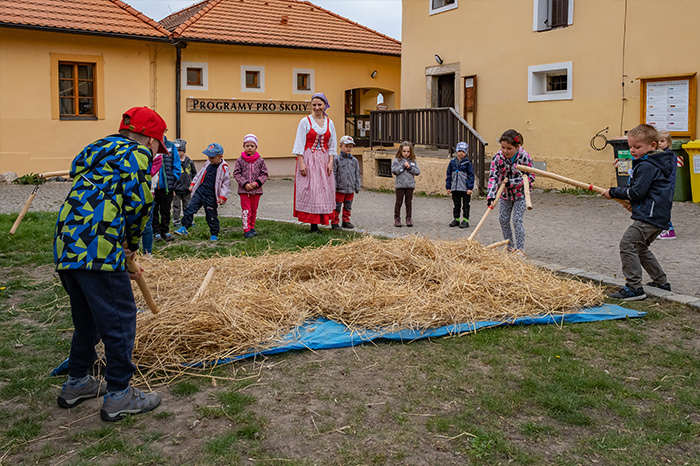
The 11th WEEC wants to be a bridge between the theory and the practice. In addition to parallel sessions shaped by researchers and scholars, we offer ten sessions, organized by nine Czech environmental education centers. At the field sessions, Congress participants may spend 1-2 days in urban or outdoor centers by discussing a broad scale of topics defined by the practitioners.
As a participant, you may engage in sharing your experience about environmental education in contemporary zoological gardens,  discuss the challenges of inquiry-based learning programs, get involved in the topic “Folk traditions and traditional crafts in environmental education”, or to the other fascinating topics.
Finally yet importantly, you may enjoy discussions in smaller groups of people of the same interest in non-formal settings and find new partners for your future projects.

4 field sessions will take place in Prague, 6 in the environmental education centers out of Prague, which also offers great opportunity to explore the host country. 5 field sessions include overnight followed by a trip with local environmental educators. Participants thus will have opportunity to explore landscapes, landmarks and tastes of Bohemian Paradise, Moravian karst, Krkonoše mountains, Brno and Bohemian – Moravian highland.

The field sessions are all-inclusive and the price covers transport, catering and the programme on site. Accommodation during 2-day sessions is € 29.

Read more about all the themes and organisers here  and look for your favorite one!

The 11th WEEC will be On-Site and On-Line

For the first time in its history, the World Environmental Education Congress is offering an opportunity to also participate in the online environment. The difficult pandemic situation shifted most of the environmental and sustainability education events to cyberspace in 2020, and while it is reasonable to expect that the situation will improve in the 2021, the on-line alternative seems to have become a new standard.
In light of this, we have decided to offer an on-line option for those who cannot come to Prague.

Options:
On-site participation is full participation. Participants who choose on-site participation get a full version of the congress (plenary and parallel sessions, field sessions and field trips). Moreover, they will have full access to all parts of the online platform, so they can access the congress materials a long time before and after the congress dates.
On-site participation supports networking. Most of the congress time is organized in smaller thematic groups to promote meeting and networking with participants with the same interests. If you are interested in meeting new people, in-depth discussion, and starting new cooperation, then the on-site option is better for you.
On-site participation is place-based and experiential. Field sessions and field trips are an important part of the congress. If you want to imagine how to link a place with the practice of environmental and sustainability education, if you want to enjoy informal chatting with people from environmental education centres, to get direct experience, then you should come to Prague.

Both on-site and on-line are safe.
Based on the experts, the pandemic situation should be resolved by the middle of 2021, when the vaccination is supposed to be in wide use throughout the population. We hope that lock-downs and travel restrictions will be a distant memory by the end of this year. Nevertheless, we will adopt strict precautions to make the congress as safe as possible.

On-line participation is more convenient, less expensive, and environmentally-friendly. Despite its clear disadvantages, on-line participation will bring you the meaningful option of participating from your home, with no travel costs and a small discount. While we have adopted a set of measures to minimize the environmental impact of the congress (we will be supplied with organic food from local sources, we will be almost paper-less, and we will offer a CO2 offset), it is clear that not to come always has less environmental impact than to come.
Please, consider your reasons for participation: if you just want a basic picture of the trends in the research and practice of ESE, if you are not pursuing new professional contacts, if you have a limited budget, perhaps the on-line option is better for you.

Notice: If you participate on-site, you will get full access to the on-line platform too. If you participate on-line, you have full access to the on-line platform.

Read here for more information

Call for interview with Prairie Climate Center

The Prairie Climate Center  is looking for teachers from all over Canada and who teaches every age group to do an online interview about their online resource, Climate Atlas of Canada.

The interview will last about 1 hour. No previous experience with Climate Atlas of Canada is required. You will be asked about the browsing experience on their site to give a  feedback in real time.

You can find all the details in the image below.


Better Ocean Data for a Better Environment with SOFAR Ocean

The Ocean is key to our life. It regulates the climate system, it produces more than 70% of the oxygen we breathe thanks to sea plants and provides us food. For these reasons, it’s very important to get to know it better in order to protect it and to manage it in a more sustainable way.

A company from San Francisco, SOFAR Ocean has a clear mission: “We connect the world’s oceans to provide insights to science, society, and industry for a more sustainable planet”.

The main goal of the company is to create data-abundant ocean to raise awareness of the risks connected to climate change, to generate a better understanding of the ocean environment and contribute to a more sustainable planet. They developed a real-time ocean weather sensor network, inspired to the way marine mammals communicate, which is able to provide data, information and forecasts about marine weather .

According to A. Reynard, writer of the article “Mitigating Climate Change: It Starts With Better Ocean Data”,  better ocean data are fundamental. The ocean has a key role in mitigating the effects of human emissions, but now this is resulting in rising sea levels, acidification and extreme weather events.

To mitigate these effects and reduce our carbon footprint we need more affordable and open data and a unified approach.

Read here the full article.

Education for achieving Sustainable Development Goals

The UNESCO World Conference on Education for Sustainable Development (17-19 May 2021) is organized by UNESCO in cooperation with and supported by the Federal Ministry of Education and Research of Germany, and with the German Commission for UNESCO as advisory partner.

This year the Conference wants to address the challenges the climate crisis and Covid-19 brought to the attention and equip learners with knowledge, skills, values and attitudes needed to contribute to a more sustainable world. In 2017, ESD (Education for Sustainable Development) was recognized by UN General Assembly as an integral element of the SDGs on quality education and a key enabler of all the other SDGs.

The goal of the Conference is to create a momentum for the new framework ESD for 2030 (that focuses on streamlining ESD with Agenda 2030) to achieve the SDGs within the next 10 years and to build education systems that support learners of all ages to be responsible and active contributors to more sustainable societies and a healthy planet.

The Conference will take place on a participatory online platform. The format of the virtual Conference will include interactive plenaries for debate and dialogue and concurrent sessions for in-depth discussion, online-workshops, virtual exhibitions and digital networking opportunities. Interaction will be key to the whole programme in order to provide a learning experience for all.

Further information on participation and how to register for the Conference will be soon available on UNESCO website.

In preparation of the UNESCO World Conference on ESD, you can participate to the pre-conference workshops to April 2021.

Subscribe now to EECOM 2021

Early registration is now open for EECOM2021.  This year, for the first time the largest National Environmental Education conference in Canada will take place online from 21-24 April 2021.

Teachers, students, classes, community organizations and parents will be welcomed. The Conference will begin on April 21 with a research symposium with some of the most eminent researchers and teachers in Canada and around the world. The following 3 days there will be dynamic sessions and workshops focused on four themes: the city as a classroom, indigenous education, eco-justice education and education relating to water.

There will be 3 opening presentations: Larissa Crawford on Earth Day, indigenous artists Christi Belcourt and Isaac Murdoch and Julian Agyeman on climate justice and more than 100 presenters over more than 70 sessions. Participants will have the opportunity to socialize with other members of EECOM community during the “Green Night”.

To find more about the program and to register, click here and for the english form here

Find out how sustainable Prague is!

The historic european city that will host the 11th World Environmental Education Congress is in continuous evolution. Prague is “striving to become a greener destination for visitors and a more sustainable city for its residents” (Sustain Europe, Prague: The City of a Hundred Spires).

The Sustainable Development Goals 2020 Index ranks countries around the world based on their performance on the 17 SDGs. In 2020 Czech Republic was at 8th place and Prague is already a green city, easy to walk and with a good public transport system.

The city is definitely committed to sustainability, thanks to its Climate Change Adaptation Strategy. There are some interesting aspects of sustainability in the city: from green spaces, to circular economy, waste management, mobility, food and so on.

Based on the Green Cities Index, Prague is the city with the highest percentage of green space per person. The City has a Tree Planting Action Plan that aims to plant 1 million new trees (beeches, oaks, firs, pine and larches) in the next eight-years in urban and open spaces to improve the microclimate and to prevent soil erosion.

Prague is also trying to make its Airport greener, by working on carbon neutrality. To achieve this goal, the Airport is considering the purchase of 100% green electricity, together with carbon offsetting projects. They even installed 5 beehives in the Airport to biomonitoring air quality.

The City is working on the transition to a circular economy, signing the European Circular Cities Declaration and managing waste production by reducing waste generation. City-wide biowaste collection and a pilot kitchen waste collection scheme are some of the interventions to reduce waste production by 50% by 2030.

For what concerns food resources, Prague aims to count on local farmland and vineyards to feed the city.  As for mobility in the capital, the public transport system is already extensive and cheap to use, but most commuters from suburban areas use private cars. For this reason, Prague has approved a Sustainable Mobility Plan that includes the introduction of electric buses, the extension of tramlines, the implementation of cycling paths and the construction of Park & Ride, Bike & Ride and Kiss & Ride facilities. Prague has also sustainable solutions for around the city, such as electric cruisers for trips along the Vtlava River or e-bikes.

To know more about sustainable planning and solutions in Prague, see Prague Adaptation Strategy here.

To see more about 11th WEEC, visit weec2022.org. We are looking forward to seeing you in Prague!

Research Grants Program for academic projects

The Spencer Foundation launches the Small Research Grants Program. It supports education research projects that will contribute to the improvement of education, broadly conceived, with budgets up to $50,000 for projects ranging from one to five years.

This program is “field-initiated” in that proposal submissions are not in response to a specific request for a particular research topic, discipline, design, method, or location. The goal is to support rigorous, intellectually ambitious and technically sound research that is relevant to the most pressing questions and compelling opportunities in education. The proposals will span a wide range of topics and disciplines that innovatively investigate questions central to education, including for example education, anthropology, philosophy, psychology, sociology, law, economics, history, or neuroscience, amongst others.

Projects that utilize a wide array of research methods including quantitative, qualitative, mixed-methods, ethnographies, design-based research, participatory methods, and historical research are welcome.

Proposals to the Research Grants on Education program must be for academic research projects that aim to study education. Proposals for activities other than research are not eligible.

Applications are accepted three times per year. The first deadline is March 1, 2021.

Read more information here

Program contact: Jasmine Janicki, smallgrants@spencer.org