
No Limits to Hope
Transforming learning for better futures
Unlocking transformative learning for a sustainable future
The “No Limits to Hope” initiative is a significant new initiative led by a flagship programme of the Club of Rome, The Fifth Element, and the WEEC Network (World Environmental Education Congress), the worldwide community of research and practice in Environmental Education. This project marks the 45th anniversary of the influential No Limits to Learning report. It aims to unlock the full potential of learning to create positive changes for people and the planet.
Why this matters
We face multiple global crises, from environmental damage to social inequality. To tackle these challenges, we must change how we think and learn. This project is designed to shift mindsets to foster a fairer, healthier world by exploring new ways of collaborative learning and problem-solving.
Key project goals
- Catalyse Cultural Change: Transforming how we think and act is imperative for building a healthier planet and creating equitable opportunities for all.
- Facilitate Transformative Learning: Use the power of learning to inspire innovation and overcome barriers to real change.
- Create new knowledge: Expand on the original No Limits to Learning (1979) report to reflect current global challenges and opportunities and offer new insights for the future.
Vision and Inspiration
Aurelio Peccei, founder of the Club of Rome, wrote in the preface of No Limits to Learning, “What we all need is to learn what it takes to learn what we should learn—and learn it.” This vision drives our project, inspiring us to rethink how we can learn together in ways that benefit both people and the planet.
Carlos Álvarez Pereira, Secretary General of The Club of Rome, explains: “When many transformative learning initiatives come together, they create the conditions for mutual learning and real change, moving us toward a healthier and more equitable world.”
Mario Salomone, Secretary-General of the WEEC Network, adds: “Learning can take us in many directions, from selfishness to cooperation, from conservative ideas to innovative ones. Unlike material growth, which has limits on a finite planet, learning is limitless.”
How we will achieve these goals
We are working on various activities to inspire action and learning worldwide:
- Workshops and seminars: Interactive events to explore how learning can drive real-world solutions to global problems.
- Research and reports: Updating the original No Limits to Learning report, reflecting on what has changed and offering new ideas for the future.
- Global conferences: Present key findings at the 13th WEEC in 2026 in Perth, Australia, and other international events in order to engage a global audience.
- Community engagement: Spark dialogue and cooperation on transformative learning by working with educators, policymakers, and community leaders.
Our audience
This research project aims to stimulate a global debate on learning by involving and addressing the international community, specifically educational organisations, scholars, academics, teachers, educators, and all practitioners.
Outcomes
International research will contribute to fostering reflection about education involving a large audience of institutions, students, researchers, scholars and teachers. Conferences and webinars will be organised to disseminate the research, and articles will be published.
Moreover, as a final tangible outcome, the project aims to publish a report in 2026 that will revisit the concepts and principles first discussed in the 1979 Report to the Club of Rome – No Limits to Learning. The book will be translated into Arabic, Chinese, English, French, Russian, and Spanish, which are allofficial languages of the United Nations. Your contribution will ensure widespread reach and engagement with the global community. All donors, supporters, and partners will be listed in the book, both in the digital and printed versions, gaining international visibility.
Why your support matters
By supporting the No limits to hope. Transforming learning for better futures initiative, you help to create meaningful change. Here’s what you gain:
- Drive systemic change for sustainability: Help create innovative learning solutions and play a key role in solving global challenges.
- Contribute to ESG goals: Your support aligns directly with the Environmental, Social, and Governance (ESG) goals of the United Nations Agenda by addressing sustainability, fostering social equity, and promoting responsible governance through collaborative learning.
- Gain recognition as a sustainable player: Align your organisation with leading sustainability and transformative education efforts, enhancing your international profile.
- Shape the future: Be part of shaping new learning approaches for a healthier planet and fairer societies.
- Network and collaborate in sustainability: Join a network of global thought leaders, educators, and innovators committed to creating lasting, positive change.
Get Involved
We invite you to join us in making a difference. By supporting this initiative, you help unlock the potential for learning to create a sustainable and equitable future.
Contact us to learn how you can support the No limits to hope. Transforming learning for better futures initiative at hope@weecnetwork.org
The seminal role of “No Limits to Learning” in 1979

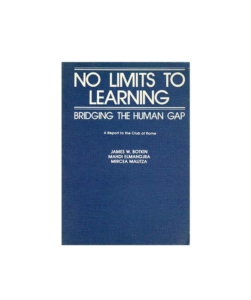
“No Limits to Learning”, edited by James W. Botkin, Mahdi Elmandjra, and Mircea Malitza, is the seventh report to the Club of Rome. It was published in 1979 in the original edition by Pergamon Press Ltd, Oxford. The report’s original English title explicitly recalls The Limits to Growth, the title of the first famous report to the Club of Rome (1972). As Aurelio Peccei explains in his preface to the volume, it closes a cycle.
The report is the result of the work, which lasted two years, of three groups set up in Bucharest, Cambridge, and Rabat to represent those who, before the fall of the Berlin Wall (1989), were the First, Second, and Third Worlds. Hundreds of people participated in the learning project, mainly voluntarily, and were involved in meetings, discussions, seminars, and conferences in Salzburg, Bucharest, Madrid, Vienna, Fez, Paris, and New York.
The report was previewed in June 1979 at an international conference in Salzburg (Austria), opened by the President of the Republic of Austria, Rudolf Kirchschläger. The report’s final draft incorporated many conference participants’ comments and suggestions. UNESCO Deputy Director-General Federico Mayor attended the conference and expressed his support for the proposal to launch a major research project on learning. He said: “This initiative by The Club of Rome for the further development of the concept of learning, placing learning in the position of the central phenomenon of new societies, is a most timely and fundamental one.”
Key objectives of the Report
In the preface, Aurelio Peccei sums up the report’s meaning: progress is “hectic and haphazard,” but men and women do not fully understand “the meaning and consequences of what they are doing.” In short, there is a “human gap” between the human condition and the natural environment “destined almost inevitably to get much wider”: humans are “increasingly at odds with the real world.” Is it possible to have “the gap bridged before a tragic and grotesque fate overtakes homo sapiens”? The answer lies in:
- Reserves of “resources of vision and creativity” to draw upon.
- “Moral energies to be mobilised.”
Peccei is optimistic: the “learning ability” – innate in every individual – can be stimulated and enhanced—no limits to learning. Solving the human divide and guaranteeing the future: “The human future can be sought nowhere else but within ourselves”. Aurelio Peccei states, ” There really is no other way of turning the global situation around than by improving human quality and preparedness—and this is, therefore, what we must do.” The No Limits to Learning report aimed “to involve as large a segment as possible of public opinion in reflections and debates”.
Become a sponsor of the initiative
No Limits to Hope is an international research project promoted by the WEEC Network and the Club of Rome to transform education and address global challenges. Through research, conferences, and publications, we aim to catalyze cultural change and foster transformative learning.
By supporting the project, you can help fund research, event organization, and the dissemination of results, gaining international visibility.
Join us in building a sustainable future! For more details, check the No Limits to Hope – Presentation and Proposal for Sponsorship.
No Limits to Hope – Frequently Asked Questions
1. Is the No Limits to Hope project recruiting staff?
No. Participation in No Limits to Hope is voluntary. We invite scholars, organisations, and institutions interested in the debate on innovative and transformative learning to follow our websites and initiatives and contribute by commenting, writing, and so on.
2. Why send an abstract?
The abstract has a double aim.
First, it is helpful for the worldwide debate on learning challenges to bridge the ‘human gap’ (as Aurelio Peccei said). We are organising webinars and meetings and will publish comments and opinions on the project’s websites.
Second, it is a preliminary step before a full paper that we will include, if accepted through a peer-review process, in a book as a supplement to the final report.
3. Is No Limits to Hope part of the 13th WEEC Congress in Perth (Australia)?
Yes. We will present the final report at the WEEC congress in Perth (21-25 September 2026), so the answer is ‘yes’: it is a pivotal part of WEEC 2026.
4. Is No Limits to Hope a conference?
No. It is a vast programme managed by The Fifth Element initiative of The Club of Rome and WEEC. A final report will be presented at the 13th World Environmental Education Congress in Perth, Australia (21-25 September 2026). The No Limits to Hope programme includes webinars, meetings, debates on the web, position papers, and, among other things, a book supplementing of the final report.
5. What is the focus of No Limits to Hope. Transforming learning for better futures? Theoretical frameworks, methodologies, innovative programmes and learning practices, pedagogical approaches, etc.?
No Limits to Hope aims to revisit the concepts presented in the report to The Club of Rome No Limits to Learning in light of current challenges. As the subtitle states, we need to transform learning for better futures. All aspects matter, and, above all, they must converge on a new, different education.
It means transforming paradigms, organisations, methodologies, programs, and theoretical approaches, turning schools and universities from a conservative education to an innovative education that can bridge the human gap between our knowledge and thinking systems and the growing problems humanity must face.
6. I can’t comply with the abstract deadline of 31st March. What can I do?
If you can’t comply with the abstract deadline of March 2025, don’t worry. There are other opportunities to contribute to the research on innovative learning in the 21st Century. There will be webinars, meetings, surveys, etc., and you can submit comments, proposals, or articles also after 31 March. Any contribution is appreciated and helpful!
7. What does No Limits to Hope want? Research, theoretical papers, case studies, or others?
All approaches are accepted (e.g., research, theoretical papers, case studies, or others). The main goal is to help us develop the project’s crucial issues and address the challenge of transformative learning.
So, instructions about the contributions apply to all texts, with some amendments if necessary. For example, all contributions need methodology, references, questions, and conclusions.
8. Is No Limits to Hope interested in published works?
Of course, the work programme of No Limits to Hope includes a literature review; in some cases, signalling papers or books could be helpful for us. But in any case, we need unpublished works, and, above all, they must be written to deepen the core issues explained in our concept note or then treated in our webinars, online debates, etc.
9. Is No Limits to Hope interested in specific education fields (e.g., outdoor, nature-based, climate, childhood, human rights, media, etc.)?
It depends. The main thing is to demonstrate that your work contributes to a new idea of learning: cultural change, a transformative approach, and innovative educational practices. Relevance to the project’s objectives and intended audiences, potential impacts on educational practices and policies, originality, innovation, and potential to inspire action and change for various audiences, as well as clarity and coherence of your thoughts, are all evaluation criteria.
10. Is the project open to contributions concerning activities implemented by NGOs and similar organisations, or is it open only to academic institutions and their research?
The call is also open to NGOs and everyone interested in issues related to the upcoming report titled No Limits to Hope.
Activities implemented by NGOs or non-academic bodies can contribute to our debate. In many cases, they can be innovative and inspiring and promote a paradigm change in education and learning worldwide.
11. When would we have to submit the final, full manuscript/ case study/ research study?
You should send the full paper (1500-4.000 words) and a short biography by 30 June 2025.
12. Do you accept only scientific articles?
Your contribution can be both academic and not academic. We accept scientific and nonscientific work. The decision to include your work will depend on the quality of the product.
13. I’ve self-published a book or an article based on the No Limits to Hope concept note; I’m wondering if this work would be eligible for this book in any way.
Yes, please send us your contribution in PDF or Word format; if it is selected as eligible during the review, we will quote or include it in the final manuscript.
14. Are you interested in research that is already underway or completed?
We are interested in research that is already completed or underway. We also consider previously published work.
