
Happy World Oceans Day!

credit: NOAA, Office of Ocean exploration and research
Join the official UN Ocean Day virtual event 2020, today here
The United Nations celebrates World Oceans Day every year on 8 June. Many countries have celebrated this special day since 1992, following the United Nations Conference on Environment and Development, held in Rio de Janeiro.
In 2008, the United Nations General Assembly decided that, as of 2009, 8 June would be designated by the United Nations as “World Oceans Day”.
Every 8 June, we have an opportunity to raise global awareness of the benefits humankind derives from the ocean and our individual and collective duty to use its resources sustainably. Future generations will also depend on the ocean for their livelihoods!
Aquariums, science centers and research institutions, NGOs, communities and governments all around the world mobilize millions of people around events big and small. Let’s celebrate all that the ocean gives us every day: from the oxygen we breathe to the inspiration that moves our poets.
More than 170 events are planned. Plan your event here
https://vimeo.com/398659233
And for thw World Oceans Day 2020 several associations signed the following Open letter:
If we have learned anything from the Covid-19 pandemic it is that we are all inextricably connected with each other and the natural world. Without greater balance and cooperation we cannot survive as a species.
Human wellbeing is at the heart of what we do. Our work, to protect the ocean is driven by the reality that humankind needs a healthy planet that can sustain life, for the sake of our homes, health, livelihoods and food.
Many have taken the rupture to our lives caused by Covid-19 to think about this and about how we can rebuild better, learning from the pandemic to achieve a greater balance and to protect the fundamentals which make life on Earth possible.
Doing so is a necessity.
We do not have the luxury of choosing between paths which damage the natural world and those which do not. If we continue to harm nature at the rate we have been, our world will not be able to sustain human wellbeing – from jobs to food security and health.
We have been given a stark warning. Once we emerge and start to rebuild, we need to do so in a way that protects the fundamentals that all human beings rely upon, foremost among these being a planet capable of sustaining human life.
Governments will be put under pressure to drop environmental protections to make it easier for industry to operate; to privilege short term economics and job increases over other considerations. These will be presented as a choice – choose humans over nature – but it is not a real choice. For the good of humankind, we must achieve balance with the natural world, a coexistence which ultimately enables us to thrive.
If we do not achieve that balance, take action to do better now, the rupture in our lives will get bigger, we will face other, escalating global disasters.
We ask governments to protect human wellbeing and to make decisions which keep a functioning blue planet beneath our feet.
Aida
Deep Sea Conservation Coalition
David Suzuki Foundation
Ecology Action Centre
Global Fishing Watch
Global Ocean Trust
Greenovation Hub
High Seas Alliance
International Programme on the State of the Ocean
Marine CoLABoration
Marine Conservation Institute
Marine Conservation Society
New Economics Foundation
Oceans North
Our Fish
Seas at Risk
Turkish Marine Research Foundation
Thames Estuary Partnership
One Ocean
Shark Project International
Wild Trust
Zoological Society of London
 Gunter Pauli, the founder of ZERI (Zero Emission Research and Initiatives) and the Blue Economy, invites everyone to reflect and ask questions, starting with those of his book “100 Questions in 100 Pages”. An invitation to question the origins and implications of this virus and to understand how to overcome the crisis, together, by using confrontation. A declaration of love to stimulate debates and change. The book is
 Unep and several other organizations launch
  The Journalism Update Course for Sustainability is organised by CapacitaRSE – a pioneering center for teaching sustainability in Latin America – with the experience of 30 journalists or communicators (bloggers, podcasters or others) active in the field in the Spanish-speaking world.
 Each year, the journal “Éducation relative à l’environnement : Regards – Recherches – Réflexions” publishes an issue outside the theme, under the responsibility of the Center for Research in Education and Training relating to the Environment and Eco-Citizenship (UQAM). This issue of the journal will be entirely made up of texts submitted spontaneously to the journal. Articles received before June 1, 2020 will be posted on the journal’s website for the month of January 2021. Be sure to visit the
 The
The  Ready, set, go! MedArtSal kick is a project to promote sustainable management of artisanal salinas in the Mediterranean. The eight partners of the project
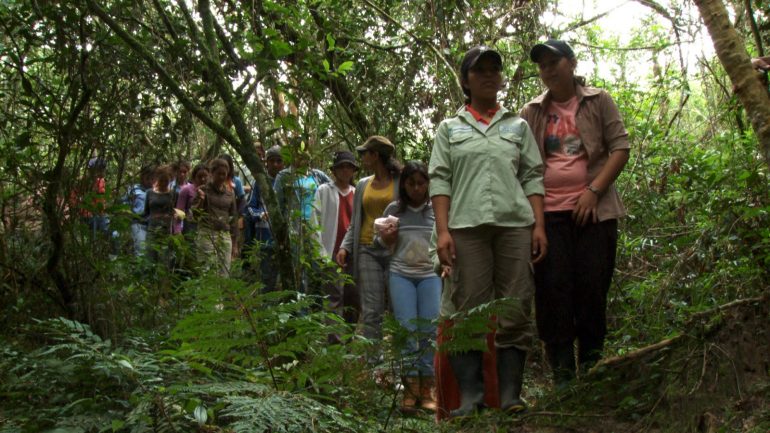 The documentary film Daughters of the forest tells the intimate, powerful story of a small group of girls in one of the most remote forests left on earth who are transformed by attending a radical high school where they learn to protect the threatened forest and build a better future for themselves.It tells the story of these girls living in a rural area where more than 95 percent of the forest has been razed for multi-national agri-businesses.
 The time of year has arrived for the Erasmus+ KA1 applications. This year