Earth Prize: a $200,000 environmental sustainability competition for students

Great opportunities for students and teachers committed to environmental issues: the Earth Prize is here! The Earth Prize is an environmental sustainability competition open to teenage students everywhere.  It will recognize the students and schools with the best solutions to accelerate positive change towards environmental sustainability, as judged by The Earth Prize Adjudicating Panel.

Every participant will engage with original bespoke materials and get personalized mentorship from university students. They will also have the opportunity to interact with our world-renowned Ambassadors and showcase their solutions to a global audience.

The winning solution will have real-world impact potential, and the winning team will receive $100,000 (from a $200,000 total prize), to be split between their school and the team members.

The registration phase runs from 1st September to 31st October. Students and supervisors are required to register for The Earth Prize using the online platform.

Upon completing registration, teams and their supervisors will be granted access to bespoke online learning material, mentoring by university students (“The Earth Prize Mentors’’), and the portal where they will submit their Registration Confirmation.
Read all the participation guidelines here

The Earth Prize is a multi-phase competition: during the submission phase (1st November 2021 – 31st January 2022) students will submit their Fresh Ideas. Then, the Earth Prize Scholars will be are announced (February 2022) and the top ten teams will are selected and announced. After a social media engagement campaign the final idea will be presented to the Adjudicating Panel. The Earth Prize Ceremony will be Saturday, 26th March 2022 when the the Earth Prize Winner and 3 Runners-up will be announced.

The team recognized as “The Earth Prize Winner” will be provided with a USD 100,000 prize. Fifty percent (50%) of the prize will be granted to the team’s school to be used in a project focusing on environmental sustainability, and fifty percent (50%) as an educational scholarship grant to be split evenly amongst the team members.

Three teams will be recognized as “The Earth Prize Runner-up” whose schools will be awarded with a USD 25,000 prize each.  One prize of USD 12,500 will be awarded to The Earth Prize Educator of the Year. And one prize of USD 12,500 will be awarded to The Earth Prize Mentor of the Year.

The Prize is organised by the Earth Foundation, founded in 2020 in Geneva (Switzerland), to inspire, educate, mentor, and empower students, schools, researchers, and young entrepreneurs with innovative ideas to tackle environmental challenges. Through its initiatives The Earth Foundation strives to build its very own ecosystem.

A call for workshops: 17th Congress on Environmental Education (ERE) 2021

The Quebec Association for the Promotion of Environmental Education (AQPERE)  announces the 17th conference on environmental education (ERE). The event will take place online on November 19, 2021.

The organizing committee invites the actors and actresses of the ERE to submit proposals for workshops falling under the theme of the colloquium “A healthy world! Issues for environmental education”.

Submit your workshop by 31 May 2021

Appel de propositions d’ateliers – Colloque AQPERE 2021

For information: communications@aqpere.qc.ca

European Natura 2000 Award: Call for top conservation initiatives open

The European Commission has launched the 2022 edition of the European Natura 2000 Award. The Award, in its sixth edition, honours leading nature conservation achievements connected to Europe’s Natura 2000 network of protected areas.
The Award raises awareness about Natura 2000, the work carried out by different organisations and individuals to safeguard these vital natural assets, and the health, cultural, societal and economic benefits the network provides to us all, as well as its value in its own right.

The award recognises excellence in the management of Natura 2000 sites and conservation achievements, showcasing the added value of the network for local economies, and increasing public awareness about Europe’s valuable natural heritage. It recognises good practices at Natura 2000 sites in five different categories: Conservation on land, Marine conservation, Communication, Socio-economic benefits, and Cross-border cooperation.
The sixth award, the Citizens’ Award, provides the public the opportunity to vote for their favourite finalist.

The Award is open to any organisation or person involved in Natura 2000, including public and local authorities, businesses, NGOs, landowners, educational institutions and individuals.

The application period runs from May 21st, the Natura 2000 Day, to September 2021 and the Award Ceremony will take place around Natura 2000 Day in May 2022.

Over the previous five editions, the Natura 2000 Award has received over 500 applications, and has celebrated 121 finalists and 29 winners. And the Citizens’ Award has received an enthusiastic response so far with over 190,000 votes cast between 2015 and 2020.

Visit the Award website now and find out how to apply!

Education as if People and Planet Matter. Present your essay and win 5,000£

Schumacher College is celebrating its 30th anniversary launching an international essay competition on the theme of “Education as if People and Planet Matter”, in collaboration with Resurgence & Ecologist magazine.
Schumacher College has pioneered and promoted a very different paradigm of values-based, holistic education over the past 30 years.

Today’s education system presents young people with a world still dominated by materialism, consumerism and the heedless exploitation of both people and the planet. It’s hopelessly ‘unfit for purpose’ as we wrestle with today’s converging crises of the Climate Emergency, ecological collapse, racial inequality and worsening social injustice.
This educational system is in urgent need of transformation if we wish to see education remaining relevant to the age of ecology and serving the purpose of the regenerative culture and sustaining the integrity of our precious planet earth.

Competition rules. Schumacher College invites you to write an essay under the title “Education as if People and Planet Matter”. The essay should be addressed to general readers, and not to either education or sustainability specialists as such. The length of the essay should be between 1,000 and 1,500 words.

The Entry Fee is £10 ( or $15.00 or €15.00) and this fee will cover the administration of the competition, with any surplus going to support learning programmes at Schumacher College.

The winner will receive a £5,000 cash prize, with an opportunity to present their essay at the anniversary event at Schumacher College in autumn 2021. A £2,000 cash prize will go to the second place, and £1,000 to the third runner-up.  The winner and two runners-up will receive their awards at the anniversary event.

Apart from the cash prize, we are also planning to publish a book of essays on “Education as if People and Planet Matter”.

To enter, complete the form.

The final deadline for the submission is 1st July 2021. Winners will be announced: 1st October

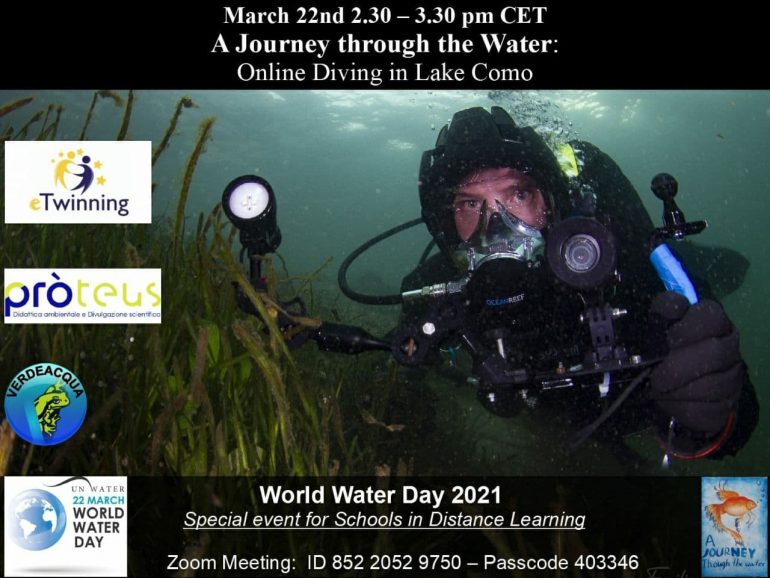
A journey through the Water: Online Diving in Lake Como

Today a special event for World Water Day 2021!
Poland, Croatia, Greece, Lithuania, Spain, Portugal, Turkey, Armenia, Slovenia, Bulgaria, North Macedonia, Italy. These are the countries that today will join the meeting “A Journey through the Water: Online Diving in Lake Como“.
Children from primary schools of these countries are participating in this wonderful event that presents Como Lake to the World thanks to the project Etwinning.
Here you can find the information to join the meeting:

ESDfor2030: UNESCO-Japan Prize

Since 2015, the UNESCO-Japan Prize on Education for sustainable development recognizes the role of education in connecting the different dimensions of sustainable development.

The Prize honours outstanding projects by institutions and organizations related to Education for Sustainable Development.

The 2021 call for nominations is open until 30 April 2021. All the information about the selection criteria, the nomination process, Prize Statutes and the International Jury are available on UNESCO website.

To know more about the Prize, read here.

PAJEP Call for paper: nature animation and environmental education in France

PAJEP, the Center for the conservation of archives of youth and popular education associations, organizes a call for paper. On 30th and 31th March 2022 the conference on History and archives of nature animation and environmental education in France in the years 1970 -1990 will take place. This event will bring together several partners and environmental education networks.

The event is conceived as the culmination of a study cycle on the theme of the history of nature-environment animation in those years. It aims to open up new avenues, to identify researchers in this field and to attempt a first synthesis of elements collected since 2016 within the framework of 6 preparatory study days.

The colloquium will bring together archivists, researchers and actors (activists and representatives of associations); this call for paper is therefore addressed to all of these networks. The organizers expect contributions from sociology, anthropology, environmental sciences, science and technology of physical and sports activities, etc.

You have time until 19th April 2021 to submit your paper


For further information about how to submit a paper and on the conference, click here

Call for interview with Prairie Climate Center

The Prairie Climate Center  is looking for teachers from all over Canada and who teaches every age group to do an online interview about their online resource, Climate Atlas of Canada.

The interview will last about 1 hour. No previous experience with Climate Atlas of Canada is required. You will be asked about the browsing experience on their site to give a  feedback in real time.

You can find all the details in the image below.


Better Ocean Data for a Better Environment with SOFAR Ocean

The Ocean is key to our life. It regulates the climate system, it produces more than 70% of the oxygen we breathe thanks to sea plants and provides us food. For these reasons, it’s very important to get to know it better in order to protect it and to manage it in a more sustainable way.

A company from San Francisco, SOFAR Ocean has a clear mission: “We connect the world’s oceans to provide insights to science, society, and industry for a more sustainable planet”.

The main goal of the company is to create data-abundant ocean to raise awareness of the risks connected to climate change, to generate a better understanding of the ocean environment and contribute to a more sustainable planet. They developed a real-time ocean weather sensor network, inspired to the way marine mammals communicate, which is able to provide data, information and forecasts about marine weather .

According to A. Reynard, writer of the article “Mitigating Climate Change: It Starts With Better Ocean Data”,  better ocean data are fundamental. The ocean has a key role in mitigating the effects of human emissions, but now this is resulting in rising sea levels, acidification and extreme weather events.

To mitigate these effects and reduce our carbon footprint we need more affordable and open data and a unified approach.

Read here the full article.

Education for achieving Sustainable Development Goals

The UNESCO World Conference on Education for Sustainable Development (17-19 May 2021) is organized by UNESCO in cooperation with and supported by the Federal Ministry of Education and Research of Germany, and with the German Commission for UNESCO as advisory partner.

This year the Conference wants to address the challenges the climate crisis and Covid-19 brought to the attention and equip learners with knowledge, skills, values and attitudes needed to contribute to a more sustainable world. In 2017, ESD (Education for Sustainable Development) was recognized by UN General Assembly as an integral element of the SDGs on quality education and a key enabler of all the other SDGs.

The goal of the Conference is to create a momentum for the new framework ESD for 2030 (that focuses on streamlining ESD with Agenda 2030) to achieve the SDGs within the next 10 years and to build education systems that support learners of all ages to be responsible and active contributors to more sustainable societies and a healthy planet.

The Conference will take place on a participatory online platform. The format of the virtual Conference will include interactive plenaries for debate and dialogue and concurrent sessions for in-depth discussion, online-workshops, virtual exhibitions and digital networking opportunities. Interaction will be key to the whole programme in order to provide a learning experience for all.

Further information on participation and how to register for the Conference will be soon available on UNESCO website.

In preparation of the UNESCO World Conference on ESD, you can participate to the pre-conference workshops to April 2021.