Travel safe and sustainable to Prague: The Czech Republic has been awarded the international “Safe Travels Stamp”

Few months remain until the 11th World Environmental Education Congress (14-18th March 2022) in Prague. We believe this will be a time when  after two difficult years we will be able to meet again in person.

Through other European cities, Prague is one of the safest city and the Czech Republic has been awarded the international “Safe Travels Stamp” by the World Tourism & Travel Council (WTTC) and now holds the status of a safe destination.

Concerning connections, Prague is becoming easier avilable with direct flights from many european city and by 2022 new air root will be added by air companies like Wizzair, Blue Air SkyUp Airlines,Ural Airlines, airBaltic, Czech Airlines or Aeroflot. KLM, Air France and Lufthansa. There are also long-haul flights to Doha, Qatar, and Dubai, which will now be serviced by three carriers, namely Emirates, flydubai and Smartwings.

Currently, it is possible to fly to 115 destinationsfrom Václav Havel Airport Prague operated by over 45 airlines. But, as flights are increaing, the Ministry of Health of the Czech Republic, Prague Airport, the Foreign Police of the Czech Republic and the Customs Administration of the Czech Republic will strengthen the control of the currently valid conditions for entry into the country.

In line with the new procedures, passengers will be jointly inspected upon arrival by employees of Prague Airport, members of the Foreign Police of the Czech Republic and the Customs Administration of the Czech Republic. According to the valid protective measures in place, upon arrival in the Czech Republic, it is checked whether, passengers have completed a Public Health Passenger Locator Form (http://www.prijezdovyformular.cz), are in the possession of a certificate of completed vaccination or a proof of the illness recovery in the last 180 days. Passengers can also submit a COVID-19 negative test result according to the rules in effect. However, the assessment of the situation will always depend on the specific case of the respective passenger and the destination from which they are arriving.

Passengers can find an overview of the currently valid conditions for entry into the Czech Republic on the Czech Ministry of Interior’s website. Specific rules are based on the list of countries according to the degree of risk, which is regularly updated on the website of the Ministry of Health of the Czech Republic

Not only safety but also beauty is one of Prague’s keystones, indeed the City ranked seventh best city in the renowed British magazine Time Out thanks to the fact that most of the interviewed praised the city’s beauty despite the lockdowns (82 %) and walkable distances with no need to use car (89 %). The Czech capital has been also ranked second when it came to opportunities to relax. This all makes Prague one of the world’s most liveable cities. Besides, the magazine highlighted the green areas of Prague, especially Prague 6 district, whose parks can be used all year round for summer picnics or winter sledging. 

For any doubts or more information, please contact us on media@weecnetwork.org

World Enviromental Education Day, the University of Quebec is ready.

In the view of the World Enviromental Education Day, a very interesting and relevant event occur in the Centr’ERE, Centre de recherche en éducation et formation relatives à l’environnement et à l’écocitoyenneté, in the University of Quebec in Montreal.

It is organized with respect for links with the past, present and future and with ancestral land rights.

These days begin the fall season of the Centr’ERE by highlighting three symbolic dates whose meanings significantly mark our relationship to education, indigenous peoples and the environment. October 5 will indeed be the International Teachers’ Day; October 12, the controversially titled “Discovery” of the Americas day, which marks very painful moments in history and inspires rebuilding ties with the First Peoples of the Americas; and October 14, International Environmental Education Day (ERE). These three dates mark out the course of a set of activities (seminars, round tables, conferences, meetings) offering complementary views on the past, present and future of the field of environmental education in the University of Quebec in Montreal, Quebec and beyond. Throughout these days, multiple windows will be opened on the abundant interdisciplinary networks between ERE and the fields of philosophy, anthropology, arts and literature, among others.

Check the full program on https://centrere.uqam.ca/evenements-a-venir/journees-ere/ 

The fourth edition of the World Environmental Education Day will take place between 9 and 17 October. The Weec Network is inviting all the stakeholders of the environmental education to join the World Environmental Education Day organizing special events to highlight the importance of environmental educational actions all over the world.

Several associations, environmental education centers, schools and institutions are sending us information about their events.

Don’t waste time, send us your ideas and what you and your organization are preparing on media@weecnetwork.org . 

The Earth Prize: registration is officially open


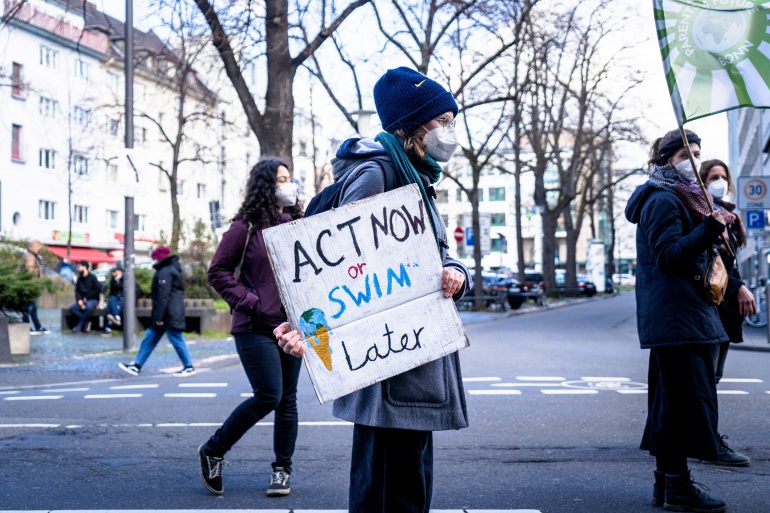
Photo by Mika Baumeister – Unsplash

Until October 31st secondary education students and teachers can register for the competition through the website, where they will then be able to:

–  Watch the bespoke learning videos covering key environmental sustainability concepts and featuring young change-makers from around the world such as Tom Szaky, Founder of TerraCycle, and Boyan Slat, Founder of The Ocean Cleanup.

– Form teams and start working on their ideas.

– Ask questions to The Earth Prize Mentors: 30 student experts from 26 top universities across 18 countries.

If you know of any secondary school teacher or student who might be interested in participating in the competition, please share this initiative with them.  The Earth Prize wants to reach as many schools and students all over the world as possible.

Mediterranean Solutions at IUCN Congress

Under the leadership of the MAVA foundation, the organisations ACCOBAMS, Conservatoire du Littoral, Critical Ecosystem Partnership Fund, the IUCN Centre for Mediterranean Cooperation, MedPAN, MedWet, The MedFund, Tour du Valat, UNEP/MAP-SPA/RAC, UNEP/MAP-Plan Bleu and WWF Mediterranean gather at the IUCN Congress to present the current challenges, accomplishments, new initiatives and collaborative work which are taking place in the Mediterranean region.
Each of these organisations harnesses different skills, operational structures and approaches. However, they all share the same goal: to kickstart a nature-based recovery across the Mediterranean, and get on course for a sustainable, equitable future that balances economic growth and the health of the natural world.

Two seminal reports published in 2020, The State of the Environment and Development (SoED) report, and the First Mediterranean Assessment Report (MAR 1) on climate and environmental change in the Mediterranean basin, shed light on the impacts of the triple crisis of climate change, biodiversity loss and pollution on the Mediterranean.

During the 6 days, the sessions at the Mediterranean stand explore solutions to the key environmental issues in the region, including Nature-based solutions, inclusive processes to support inclusivity and effective and equitable governance, as well as an analysis of the current funding landscape.

This is the first hybrid IUCN Congress in-person and virtual environmental event since the pandemic began, the Mediterranean stand will provide streaming service for most of the live events scheduled by this innovative collaboration.

ALL EVENTS  WILL BE LIVE-STREAMED through this link:
https://virtualmeeting.leni.fr/UICN21/A28/indexSuite.php

For further details read here

or IUCN World Conservation Congress website

Download the brochure here

For further enquiries, please contact Arantxa Cendoya at arantxa.cendoya@iucn.org

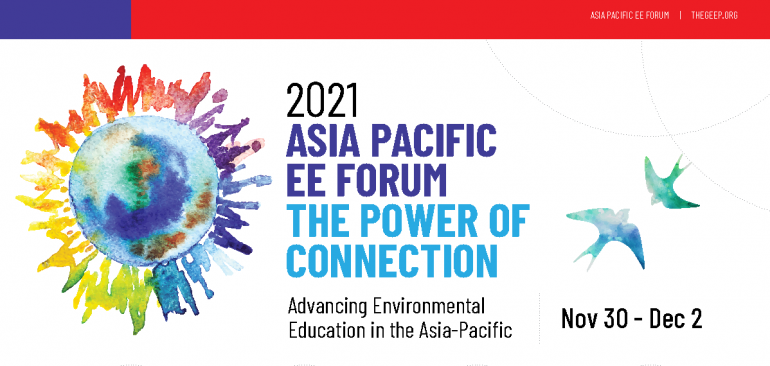
GEEP Asia Pacific Forum. Save the date!

Join the GEEP (Global Environmental Education Partnership) from November 30—December 2, 2021, for a three-day forum designed to strengthen environmental education in the Asia-Pacific region. This virtual forum is free and open to anyone who is interested in the power of environmental education in creating a sustainable future. Participants will have a chance to hear from leading environmental education experts and network with others from the region who are advancing key environmental and social issues. There will also be opportunities for networking with environmental education professionals from across the region to learn, share, and strengthen collaboration.

This forum will explore:
– How environmental education can help address large-scale environmental and social issues, including climate change, environmental justice, biodiversity loss, air quality, and marine litter;
– The role of networks, and how to build stronger regional and country-level networks that strengthen the impact and promote collaboration across borders and sectors; and
– How we can build leadership in the region and transition to a more just and sustainable future.

Download the promotional flyer

Balkan: from a War Massacre Site to a Sustainable School

The elementary school Vladimir Nazor, in Croatia, is now “The Blue Economy Happy School “.
It took three years between the formulation of the idea and the reality. Students, parents and the school leadership wanted to overcome once and for all the traumas inflicted by the Balkan War by transforming their dilapi dated building into an example from which the world can learn.

Their project proposal received in 2018 the Sustainability Prize of the Emirate-based Foundation honoring Sheikh Zayed, the Founder of the United Arab Emirates. The $100,000 award money kickstarted a revolutionary transformation that mobilized a total of €700,000 thanks to additional support from the Zadar County and the European Union.

Now a 30 kW solar power plant supplies electricity for LED lighting and solar backpacks can be used by students on field trips. An ultrafast, super-secure and energy saving internet operates on light (LiFi), the first in Croatia and one of the first in Europe. An electric vehicle powered by the solar provides for all transport needs for the school, especially the kitchen. When the school is closed for weekends and holidays then all power is distributed to the local community.

Leonarda Skara

Students are now proud of their school, an infrastructure that was first built in 1876. They wish to create a portfolio of new businesses, securing a future for their community that already harbors the largest organic olive orchard in Croatia. They do not wait to take initiative after graduation and created a student cooperative “Maslina” selling olive oil from the school gardens. Now they are ready to convert the 30 kg of clippings per tree into 15 kg of mushrooms generating more income and job opportunities.  “We want to have a future right here at home” commented Leonarda Skara who went to Abu Dhabi to collect the Prize and who is leading the students in their enthused transformation of the war torn region.

The success story of the Vladimir Nazor Elementary and Middle School in Škabrnja will serve as an inspiration for all village schools around the world demonstrating that a new future is possible even when the dramas of the past are hard to accept nor forget. A video documenting this transformation will be translated into five UN languages and will be distributed through a video and text to the global network of Zayed Sustainability Prize schools.

”The Ministry of Science and Education is happy that the students and employees of the Vladimir Nazor Elementary School, from the small Zadar municipality of Škabrnja, demonstrated their resolve to embrace the future”, said Vesna Šerepac, Director of Education at the Ministry of Science and Education. The inauguration ceremony was attended by Prof. Gunter Pauli, known as “The Steve Jobs of Sustainability” representing The Zayed Sustainabilty Prize where he serves as a member of the committee; the Prefect of Zadar County Božidar Longin; Prof Ivan Šimuni Head of Education for Zadar county; and Darko Parić CARNET Public Administration co operation advisor.

Earth Foundation: looking for university students mentors for the Earth Prize

The Earth Foundation is looking for university students interested in involving as mentors for the young people applying the Earth Prize. Becoming an Earth Prize Mentor is a unique opportunity for university students to share and expand their knowledge on environmental sustainability and entrepreneurship, by advising participants in The Earth Prize, a $200,000 global youth environmental sustainability competition for students between the ages of 13 and 19.

Mentors will contribute to the development of students’ innovative project proposals by offering them guidance on their ideas and answering their questions. Mentors who will have demonstrated the highest levels of engagement will be given the chance to work individually with one of the ten The Earth Prize Finalists.

Each year, the most engaged mentor, as voted by the The Earth Prize participants, will be recognized with the Mentor of the Year award and a $12,500 prize.

All mentors will become part of The Earth Prize Alumni Association, a community of inspiring individuals and organizations offering mentorship, networking, internships, and professional placement opportunities.
Mentors  will have access to a unique network of entrepreneurs thanks to The Earth Foundation’s incubator partnerships and they will be able to connect with inspiring new start-ups leading the way towards environmental sustainability.
Mentoring for the The Earth Prize offers an excellent opportunity to develop and showcase transferable skills such as project management, problem-solving, and consulting. Each mentor will receive a certificate upon completion.
All mentors will have access to The Earth Prize learning platform featuring bespoke online materials on environmental issues, interviews with activists and social entrepreneurs, and real-world practical skill training on how to effect change.

Joining The Earth Prize as a mentor allow to actively contribute to projects striving to make a positive impact on the environment and to serve as a role model for younger students, inspiring them to become future changemakers.

Application will close June 30thFill the form here to become a mentor.


UNESCO: environmental education must be a core curriculum component by 2025

The Unesco World Conference on Education for Sustainable Development, followed online by over 10,000 viewers, was organized by UNESCO in cooperation with the Federal Ministry of Education and Research of Germany and the German Commission for UNESCO as advisory partner.
Over 80 ministers and vice ministers and 2,800 education and environment stakeholders committed to taking concrete steps to transform learning for the survival of our planet at the end of a three-day virtual World Conference held from 17 to 19 May.

UNESCO has called for Education for Sustainable Development to be a core component of all education systems at all levels by 2025. The Berlin Declaration on Education for Sustainable Development outlines a range of policies to transform learning encompassing teaching, learning, professional training and civic engagement. It also highlights the need to implement Education for Sustainable Development with focus on cognitive skills, social and emotional learning, collaboration skills, problem solving, resilience-building.

«We need training for sustainable development not to be a privilege but accessible to all people. The success of the Education for Sustainable Development programme for 2030 will bring us closer to all the SDGs» said German Chancellor Angela Merkel in her welcoming address, describing Germany’s broad network of partners working on sustainability at all levels of education and training.

Laurent Fabius, who presided COP21 where the Paris Agreement was sealed, stated the «fight against climate change begins at school.» He recalled commitments in the Paris Agreement to education, and called for increased efforts to improve teacher training on ESD and increase financing. «2021 is the year in which we will overcome the pandemic and embark on a sustainable development model for the future that must include ESD. If we miss this occasion, we will lose decades. This is a race against the clock.”»

The voices of young people were given a platform throughout the Conference, as those leading the call for change so that they can #LearnForOurPlanet.

The adoption of the Berlin Declaration will create momentum for the implementation of ESD for 2030 Roadmap – the framework for this decade of Education for Sustainable Development. Every UNESCO Member State will be asked to create a network of actors who together can implement the ambitious vision for education.

From Berlin, 2021 will provide key opportunities for governments to apply this commitment, including the United Nations Biodiversity Conference (COP 15) and the United Nations Climate Change Conference (COP26) in Glasgow.

Frontiers of Knowledge Awards 2021

The BBVA Foundation Frontiers of Knowledge Awards, undertaken in collaboration with the Spanish National Research Council (CSIC), recognize and reward world-class research and artistic creation, prizing contributions of singular impact for their originality and significance.

These are the categories

·   Basic Sciences (Physics, Chemistry, Mathematics)

·   Biology and Biomedicine

·   Information and Communication Technologies

·   Ecology and Conservation Biology

·   Climate Change

·   Economics, Finance and Management

·   Humanities and Social Sciences

·   Music and Opera

Award content: 400,000 euros, a diploma and a commemorative artwork in each of their eight categories.

Candidates: One or more natural persons of any nationality, without limitation of number, that have made independent or convergent contributions to a given advance. The awards are also open to scientific or cultural organizations that can be credited with exceptional contributions to scientific knowledge, cultural creation or the fight against climate change.

Awards may not be granted posthumously.

Nominations will be submitted by scientific or artistic societies, public or private R&D centers, hospital departments and biomedical research centers, schools of music, orchestras, public agencies and scientific, cultural and environmental organizations, and any other organizations stated in the call conditions.

Information and enquiries: awards-info@fbbva.es

The closing date for submissions is June 30, 2021, at  23:00 GMT.

Click here for further information and full entry conditions

Zayed Sustainability Prize 2022 Expands Global Reach with Submissions from Record 151 Countries

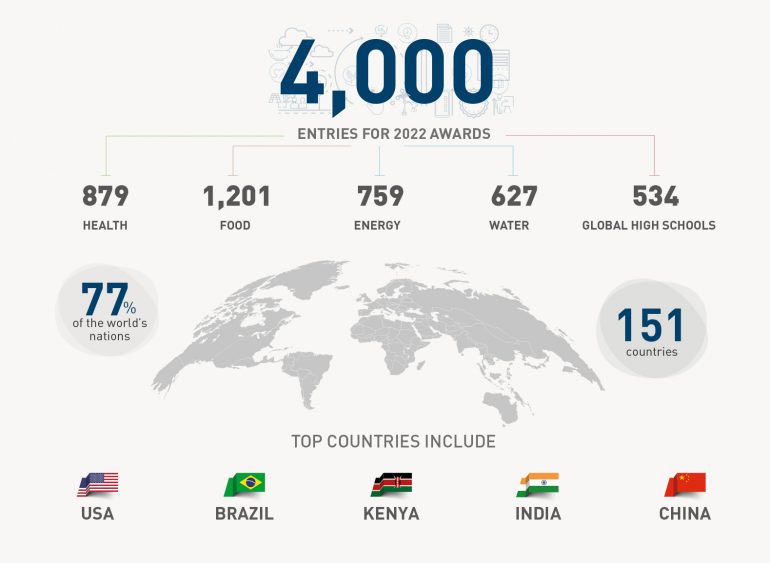
Following a six-month submissions phase amidst the prevailing restrictions imposed by the global COVID-19 pandemic, the Zayed Sustainability Prize, the UAE’s pioneering global award in sustainability, has officially closed entries for its 2022 awards. With a remarkable 4,000 applications received, the Prize marked a notable 68.5% increase in submission entries compared to the previous cycle.

Attracting submissions from a record 151 countries, representing over three quarters of the world’s countries, the Prize proves to be truly global in its reach and impact. This includes a significant number of entries from innovative, knowledge-based economies, all hoping to have their world-changing solutions and technologies recognised and scaled amidst a rapidly evolving global landscape.

The submissions for the upcoming awards, to be held in January 2022, reflect the current global climate in the lead up to COP26 and in the wake of post-pandemic recovery, with Food (1,201) and Health (879) as the top categories to attract a high number of pioneering solutions, followed by Energy (759) and Water (627). With 534 submissions, the Global High Schools category is perhaps one of the most inspiring results as completing entries in the face of extensive disruption and school closures is a clear sign of the global youth’s commitment to a sustainable future.

H.E. Dr. Sultan Ahmed Al Jaber, UAE Minister of Industry and Advanced Technology and Director General of the Prize, said: “As the international community continues to unite around ambitious climate action in the lead up to COP26, the high level of participation registered this year further demonstrated that creative sustainable solutions can come from every part of the world, and importantly can deliver tangible economic benefits along with social progress.”

Since its launch in 2008, the US$3 million Prize has, directly and indirectly, transformed the lives of over 352 million people across 150 countries. Its global impact continues to grow, as it further catalyses humanitarian outreach and sustainable development. Each category winner receives a prize fund of US$600,000. The Global High Schools category winners split the amount among six high schools from six world regions, each receiving up to US$100,000.

The winners of the 2022 awards will be announced at the Prize’s awards ceremony that will take place during Abu Dhabi Sustainability Week, in January 2022